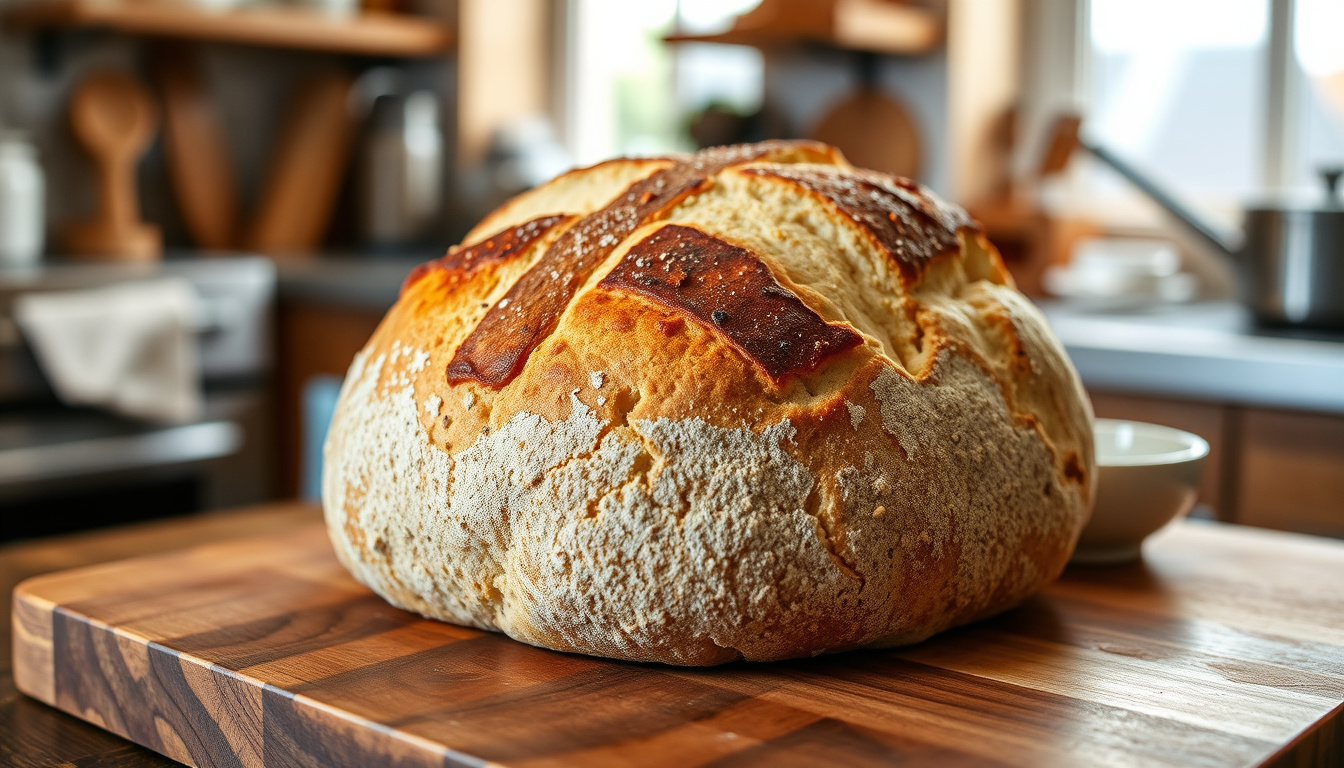
There’s something special about pulling a warm loaf of brown bread from the oven, especially when it comes together in under an hour with no kneading or yeast. This traditional Irish soda bread relies on buttermilk and baking soda for its rise, giving it a tender crumb and tangy flavor that pairs perfectly with soups and stews.
Prep time: 10 minutes ·
Cook time: 35 minutes ·
Total time: 45 minutes ·
Yield: 1 loaf (12 slices) ·
Difficulty: Easy ·
Calories per slice: ~150 kcal
Quick snapshot
- Buttermilk and baking soda react to create carbon dioxide for leavening (King Arthur Baking Company (professional baking resource)).
- Traditional Irish brown bread uses a mix of wholemeal and all‑purpose flour (Ethnic Spoon (food blog specializing in heritage recipes)).
- Optimal hydration ratio for different wholemeal flours varies by brand and grind.
- Exact glycemic index of homemade brown bread compared to commercial versions is not well studied.
- The effect of substituting honey vs molasses on final sweetness and browning is not standardized.
- Bake at 400°F for 35–40 minutes; loaf sounds hollow when tapped (Pass The Butter (home baking blog with tested recipes)).
- Cool at least 30 minutes before slicing for best texture (Panning The Globe (culinary site with global recipes)).
Six key attributes tell the story of this traditional loaf, from its Irish roots to the baking details that matter.
| Attribute | Detail |
|---|---|
| Origin | Ireland |
| Main flour | Wholemeal (stoneground whole wheat) |
| Leavening agent | Baking soda (not yeast) |
| Typical liquid | Buttermilk |
| Flavor profile | Tangy, nutty, slightly sweet |
| Baking time | 35–40 minutes at 200°C (400°F) |
The pattern: every element here is chosen for speed and simplicity — no yeast, no long proof, no complex shaping. That’s what makes this bread a weeknight staple in Irish kitchens.
What does adding buttermilk to bread do?
Why is buttermilk used in bread?
- Buttermilk’s acidity reacts with baking soda to produce carbon dioxide, giving the bread its rise without yeast (King Arthur Baking Company (professional baking resource), cited above).
- The acid also tenderises gluten strands, resulting in a softer, more tender crumb compared to plain milk or water.
- It contributes a distinct tangy flavour that balances the nuttiness of wholemeal flour.
How does buttermilk affect texture?
- By weakening gluten, buttermilk prevents the bread from becoming tough or rubbery – essential for a no‑knead dough.
- The fat content in buttermilk (even low‑fat versions) adds moisture, keeping the loaf from drying out during the relatively short bake.
What kind of bread uses buttermilk?
- Irish soda bread (brown and white versions) is the classic example.
- American buttermilk biscuits, Southern cornbread, and some scone recipes also leverage buttermilk for lift and tenderness.
The implication: buttermilk does triple duty – leavening, tenderising, and flavouring – which is why replacing it with plain milk or water changes the bread completely.
How to make traditional Irish brown bread?
What are the ingredients for Irish brown bread?
- 250g wholemeal flour (preferably stoneground)
- 250g all‑purpose flour
- 1 teaspoon baking soda (bread soda)
- 1 teaspoon salt
- 420ml buttermilk (plus extra if needed)
- 1 tablespoon honey or molasses (optional, adds sweetness and colour)
Most Irish recipes use a 50:50 blend of wholemeal and white flour to balance flavour and structure (Ethnic Spoon (food blog specializing in heritage recipes), cited above).
Step‑by‑step instructions
- Preheat oven to 200°C (400°F). Line a baking sheet with parchment or lightly grease a loaf tin.
- In a large bowl, whisk together flours, baking soda, and salt.
- In a separate bowl, combine buttermilk and honey (if using).
- Pour wet ingredients into dry and mix with a spatula until just combined — do not overmix. The dough should be soft and slightly sticky (King Arthur Baking Company (professional baking resource), cited above, describes it as “more of a stiff batter than a soft dough”).
- Turn dough onto a floured surface, gently shape into a round, and place on the baking sheet. Cut a deep cross on top (this helps the bread bake evenly and is said to let the fairies out).
- Bake for 15 minutes at 200°C, then reduce temperature to 190°C (375°F) and bake another 20–25 minutes (if using a loaf tin, bake at 400°F for 35–40 minutes per Pass The Butter (home baking blog with tested recipes), cited above).
- Test doneness: the loaf should sound hollow when tapped on the bottom and/or reach an internal temperature of 200°F (Ethnic Spoon (food blog specializing in heritage recipes), cited above).
- Cool on a wire rack for at least 30 minutes before slicing (Panning The Globe (culinary site with global recipes), cited above).
How to make the best brown bread?
- Use fresh baking soda – opened boxes lose potency after 6 months.
- Don’t overmix: stir just until the flour disappears; lumps are okay.
- For a softer crust, wrap the warm loaf in a tea towel as it cools.
- If using a loaf pan, grease and line it well to prevent sticking.
The trade‑off: a lighter, free‑form round develops a thicker, crustier shell, while a loaf pan yields a softer crust and more uniform slices – choose based on how you plan to serve it.
The entire process takes under an hour and requires no special equipment. For a home baker short on time, this recipe delivers a fresh, wholesome loaf with fewer than 10 ingredients and zero rising time.
Is brown bread ok for diabetics?
Is there a bread that won’t spike my blood sugar?
- Whole grain brown bread has a lower glycemic index than white bread due to its higher fibre content (King Arthur Baking Company (professional baking resource), cited above, notes the wholemeal flour’s fibre helps slow sugar absorption).
- Fiber in wholemeal flour slows carbohydrate digestion and glucose release.
- Portion size still matters – one slice (about 30g) is a reasonable serving; consult a dietitian for personalised advice.
Carbohydrates and diabetes: what you need to know
Irish brown bread contains around 20–25g of total carbohydrate per slice, primarily from whole grains. Unlike white bread, the presence of bran and germ means the sugars hit the bloodstream more gradually. However, no bread is “free” for those managing blood sugar; pairing it with protein (eggs, cheese, or nut butter) can further blunt the spike.
The pattern: brown bread’s fibre advantage is real, but it still counts toward daily carb allowance. For someone with diabetes, this bread is a better choice than white – but not a carb‑free pass.
When should you not use buttermilk?
How to know when buttermilk has actually gone bad?
- Spoiled buttermilk develops an off‑smell (sour gone “cheesy”), visible curdling that doesn’t re‑emulsify, or mould on the surface.
- Buttermilk can be used past the sell‑by date if it still smells fresh and is not curdled – the acidity actually preserves it longer than regular milk.
- If buttermilk is unavailable, substitute: add 1 tablespoon of lemon juice or white vinegar to 240ml (1 cup) of milk and let stand 5 minutes (The Fresh Cooky (home‑baking recipe developer) confirms this works in brown bread recipes).
What are the signs of spoiled buttermilk?
- Strong, unpleasant odour (like sour cream gone bad).
- Lumpy texture that persists after shaking – fresh buttermilk is thin and pourable.
- Mould growth – discard immediately.
The catch: buttermilk is more forgiving than regular milk, but when it goes, it goes fast. If you’re unsure, the smell test is reliable: fresh buttermilk smells pleasantly sour; spoiled buttermilk smells foul.
If you substitute buttermilk with the milk‑plus‑acid trick, reduce the liquid slightly because the substitute is thinner than real buttermilk. Adding a tablespoon of extra flour can compensate for the loss of body.
What are the 7 common bread making mistakes and how do you prevent them?
Overmixing the dough
Overmixing develops gluten, making brown bread dense and tough. Stir only until the flour is incorporated – a few streaks are fine.
Not weighing ingredients
Flour volume can vary widely. Weighing gives consistent hydration – for brown bread, stick to the 50:50 flour ratio by grams.
Wrong oven temperature
Too low and the bread won’t set; too high and the crust burns before the centre cooks. Use an oven thermometer (King Arthur Baking Company (professional baking resource), cited above, recommends 375°F for a loaf pan).
Expired baking soda
Baking soda loses power over time. Test: drop a spoonful into vinegar – if it doesn’t fizz vigorously, buy a new box.
Not preheating properly
This bread needs high initial heat to kick‑start the baking soda reaction. Preheat fully before the dough goes in.
Cutting too early
Slicing while hot compresses the crumb and releases steam, making the loaf gummy. Wait at least 30 minutes (Panning The Globe (culinary site with global recipes), cited above, advises a minimum 30‑minute cool).
Skipping the rest
Let the dough rest for 5 minutes after mixing – it hydrates the flour and makes shaping easier.
The consequence: each mistake changes the outcome predictably – a dense loaf, a burnt crust, or a flat cake. The remedies are simple and translate directly to better results.
What’s unclear
Confirmed facts
- Buttermilk and baking soda react to create carbon dioxide (King Arthur Baking Company (professional baking resource), cited above).
- Wholemeal flour contains significantly more fibre than refined white flour (King Arthur Baking Company (professional baking resource), cited above).
- Baking soda must be fresh to ensure proper rise – test with vinegar (Ethnic Spoon (food blog specializing in heritage recipes), cited above).
What’s unclear
- Optimal hydration ratio for different wholemeal flours is not standardised.
- Exact glycemic index of homemade brown bread versus store‑bought is not widely published.
- The effect of substituting honey vs molasses on final sweetness and browning is not standardized.
Expert tips in their own words
“Mix the flour, bread soda and salt together in a bowl. Combine the egg with the buttermilk and honey then mix into the flour.”
– Bord Bia (Irish Food Board, government agency for food promotion)
“Wholemeal Buttermilk Brown Bread… Prep: 5 mins…”
– Chef Shane Smith, RTÉ Today Show (as posted on Facebook)
The pattern: from a government food board to a TV chef, the message is the same – this is a quick, forgiving bread that rewards simplicity.
Summary: what this means for your kitchen
Buttermilk brown bread is not just a recipe – it’s a system: no yeast, no kneading, one bowl, under an hour. For the home baker in an Irish or UK household, that translates to a real‑food alternative to commercial sliced bread that can be on the table before a stew finishes simmering. The implication is clear: you can bake a better, healthier loaf with less effort than a trip to the supermarket.
For the Irish home cook juggling weekday dinners, the choice is straightforward: keep a bag of wholemeal flour and a carton of buttermilk in the fridge, and a warm, crusty loaf is never more than 45 minutes away – or you fall back on the bread aisle, where alternatives carry more preservatives and less fibre.
For a trusted take on this classic, try Odlums brown bread with buttermilk, which uses the same no-yeast method for a tangy, soft loaf.
Frequently asked questions
Can I use whole wheat flour instead of wholemeal?
Yes, but wholemeal (stoneground) gives a coarser, more traditional texture. Standard whole wheat works, but the crumb may be slightly denser.
How long does brown bread last?
Up to 3 days at room temperature wrapped in a tea towel, or 5 days in the fridge. Toasting revives the texture.
Can I freeze brown bread with buttermilk?
Absolutely. Cool completely, wrap tightly in plastic and foil, and freeze for up to 3 months. Thaw at room temperature and refresh in a warm oven.
What is the best pan for baking brown bread?
A loaf pan (9×5 inch) yields a softer crust and even slices. A baking sheet with a free‑form round gives a crustier exterior – both work.
Can I add seeds or nuts to the recipe?
Yes. Fold in up to 100g of seeds (sunflower, pumpkin) or chopped nuts after mixing the wet and dry ingredients. Adjust liquid if the dough feels too dry.
Why did my brown bread come out too dense?
Likely overmixed, expired baking soda, or too much flour. Weigh ingredients and stir just until combined. Test your baking soda with vinegar before use.
Is brown bread gluten‑free?
No – traditional wholemeal flour contains gluten. For a gluten‑free version, use a certified gluten‑free wholemeal blend and add 1 teaspoon xanthan gum for structure.
How do I make buttermilk at home?
Add 1 tablespoon of lemon juice or white vinegar to 240ml of milk. Stir and let stand 5 minutes until it curdles. Use immediately in the recipe.
Related reading
- Apple and Blackberry Crumble – Mary Berry’s Top Recipe – a classic Irish dessert that pairs with a slice of brown bread.
- Best Beef Stew Dumplings Near Me in Dublin – the perfect main course to serve alongside this brown bread.