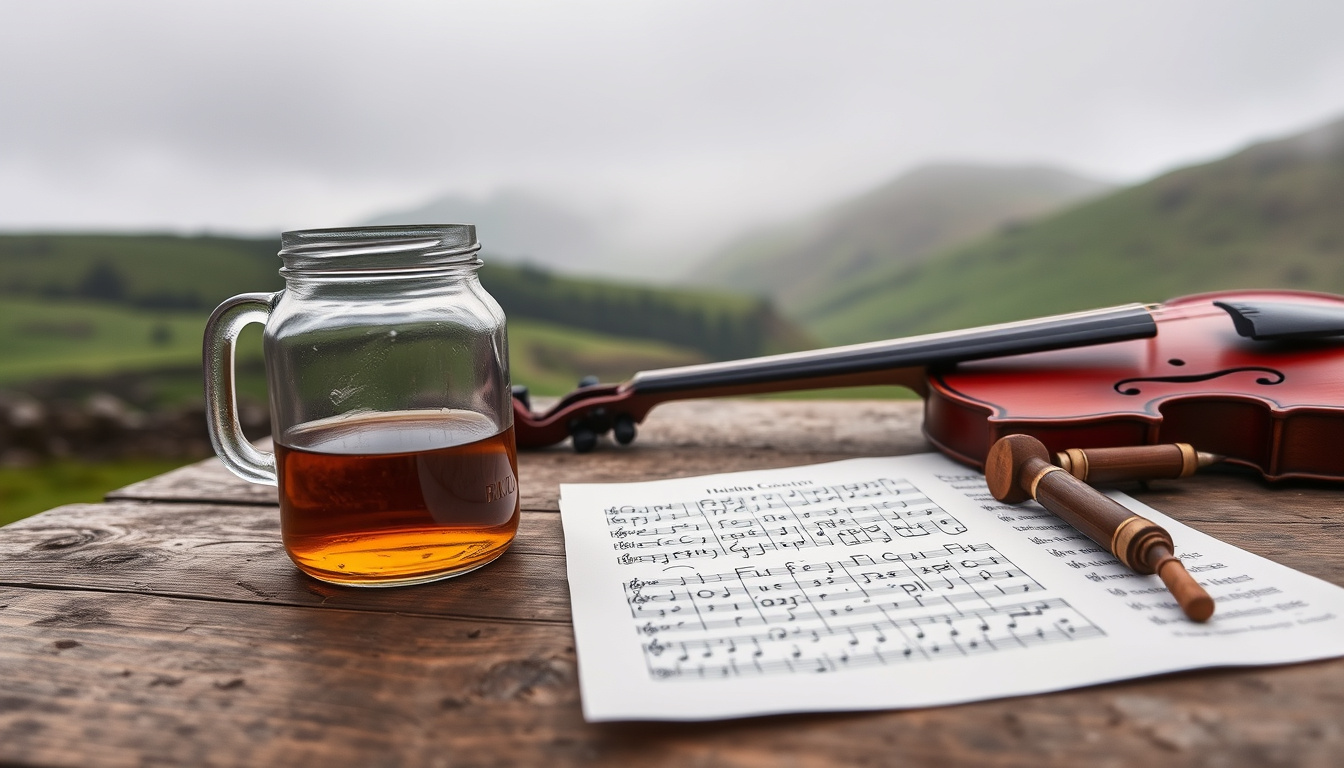
There’s something about a song that refuses to stay in its century. Whiskey in the Jar began as a 17th-century Irish highwayman’s tale, passed along in taverns and later on broadsheets, and somehow ended up as a hard-rock anthem blasted from stadium speakers, complete with a chorus in what sounds like Irish Gaelic—musha rain dum a doo dum a da—that nobody quite agrees on the meaning of.
Traditional Irish song: originates in 17th century · Roud index number: 533 · Notable recorded versions: Thin Lizzy, Metallica, The Dubliners, The Pogues · Metallica cover peak chart position (Billboard 200): No. 1 in 2008
Quick snapshot
- The song is a traditional Irish folk ballad, likely originating in the 17th century (Wikipedia).
- It has been recorded by hundreds of artists since the 1950s (Wikipedia).
- Thin Lizzy’s 1972 version reached No. 6 on the Irish Singles Chart (Charlton Bruce).
- Metallica’s cover won a Grammy for Best Hard Rock Performance in 1999 (Grammy Awards).
- The exact meaning of the chorus “musha rain dum a doo dum a da” is debated by scholars (Wikipedia).
- Whether the song’s protagonist is based on the historical highwayman Patrick Fleming is uncertain (IrishCentral).
- No single “original” performer exists; the song is in the public domain (Wikipedia).
- 17th century: Song originates in Ireland as a ballad about a highwayman (Wikipedia).
- mid-19th century: First printed versions appear in song collections (Wikipedia).
- 1960s: The Dubliners record the first commercially successful version. (Wikipedia)
- 1972: Thin Lizzy releases a hard‑rock version, their first hit (Charlton Bruce).
- 1998: Metallica covers the song on Garage Inc., winning a Grammy. (Wikipedia)
- The song continues to be performed by new artists; a 2021 cover by The Corrs reached streaming playlists globally (IrishCentral).
- Irish-language revival groups explore translating the chorus into modern Irish Gaelic (IrishCentral).
Here is a quick reference for the key details of the song.
| Attribute | Value |
|---|---|
| Genre | Irish traditional folk / folk rock |
| Roud Folk Song Index | 533 |
| Earliest known manuscript | mid-19th century |
| Number of known recordings | hundreds, including 50+ professional covers |
Is Whiskey in the Jar an old Irish song?
Origins in 17th‑century Ireland
- Alan Lomax, the American folklorist, suggested the song originated in the 17th century and that John Gay may have heard an Irish ballad‑monger sing it, influencing The Beggar’s Opera (1728) (Wikipedia).
- The tune resembles a broadside ballad called “Patrick Fleming” or “Patrick Flemmen he was a Valiant Soldier” (Wikipedia).
- The song appears in a form close to the modern version in a mid‑1850s broadsheet titled “The Sporting Hero, or, Whiskey in the Bar” (Charlton Bruce).
The pattern: the highwayman‑ballad genre flourished in the 17th and 18th centuries, and “Whiskey in the Jar” fits neatly into that tradition. What this means: the song is genuinely old—likely over 300 years—but its exact birth year is lost.
Connection to highwayman Patrick Fleming
- Some modern retellings identify the song’s protagonist with the highwayman Patrick Fleming, who was executed in 1650 according to related broadside tradition (Wikipedia).
- IrishCentral reports that the song was written around the time of Cromwell’s invasion of Ireland (IrishCentral).
The catch: no direct evidence links the ballad to a specific historical robber. The name “Patrick Fleming” appears in a related broadside, but scholars treat it as a folk‑memory rather than proven authorship.
What does musha rain dum a doo dum a da mean?
Translation and origin of the chorus
- The phrase is a phonetic English approximation of Irish language words. “Musha” is an Irish exclamation (equivalent to “indeed” or “well!”). The rest is often interpreted as nonsense syllables mimicking Irish Gaelic rhythm (Wikipedia).
- An alternative theory suggests “rain dum a doo” is a corruption of an Irish phrase containing “rinne” (did) in a grammatical structure that no longer has a clear modern translation (IrishCentral).
Why this matters: the chorus is the song’s signature, but almost nobody singing it knows what the words mean. The trade‑off: the chant‑like syllables give the ballad its driving energy, even as the literal meaning evaporates.
A song about an Irish highwayman, passed down for centuries, has a chorus that even native Irish speakers can’t fully decode. The melody outlives the language.
The catch: the more closely you examine the chorus, the less certain its meaning becomes, yet it remains the song’s most recognizable feature.
Who originally performed Whiskey in the Jar?
Earliest known recordings
- The song is traditional and has no single original performer. It existed in oral tradition before any recording (Wikipedia).
- Field recordings from the early 20th century exist, collected by folklorists such as Alan Lomax (Wikipedia).
- The first known commercial recording was by The Dubliners in the 1960s, which brought the song to a mass audience (Wikipedia).
The implication: the question “who originally sang it” misunderstands the folk process. The song belongs to nobody and everybody. Modern attribution is often given to arrangers, not composers.
Role of The Dubliners
- The Dubliners recorded “Whiskey in the Jar” for their 1968 album A Drop of the Hard Stuff, helping standardize the lyrics most familiar today (Wikipedia (The Dubliners)).
Did Thin Lizzy record Whiskey in the Jar?
Thin Lizzy’s 1972 version
- Thin Lizzy released their electrified version on November 3, 1972 (Charlton Bruce).
- It became their first major hit, reaching No. 6 on the Irish Singles Chart and charting in the UK (Official Charts Company).
- Phil Lynott’s vocal delivery and the band’s twin‑guitar arrangement turned the folk ballad into a hard‑rock anthem (Charlton Bruce).
What this means: Thin Lizzy’s cover didn’t just popularize the song—it redefined it. For a generation of listeners, the distorted guitars and Lynott’s swagger became the sound of “Whiskey in the Jar.”
Thin Lizzy’s 1972 single is the most influential rock version, but it was The Dubliners who first put the song on wax. The two recordings represent opposite poles: raw folk and electrified rock.
The pattern: each generation reinterprets the ballad in its own sonic language, securing its survival.
Impact on the song’s popularity
- The Thin Lizzy version introduced the song to a wider international audience and inspired later covers by Metallica, The Pogues, and many others (Charlton Bruce).
What is the Irish version of Whiskey in the Jar?
Differences in lyrics and setting
- The song is often set in southern Ireland, especially counties Cork and Kerry, with lyrics that mention specific landmarks and accents (Wikipedia).
- Variants place the action in Kilmoganny, Cork, Sligo Town, and even the American South (Ozarks, Appalachia) (Wikipedia).
- Common themes: a highwayman is betrayed by his lover (often named Molly) and ends in prison. The “Irish version” typically omits any American relocation (IrishCentral).
The pattern: the song has no single authoritative text. Each region and performer adapts the names and places to their own context, which is exactly what folk tradition does.
Who is the original artist of Whiskey in the Jar?
Clarifying the folk process
- No single original artist exists; the song is in the public domain. Most printed versions trace to 19th‑century broadsides and songbooks (Wikipedia).
- Collectors attribute the earliest known printed version to a mid‑19th‑century broadsheet, not a named composer (Wikipedia).
- Modern attribution—when needed for copyright or publishing—is often credited to the arranger (e.g., Thin Lizzy’s version credits Phil Lynott as arranger) (Wikipedia (Thin Lizzy)).
The trade‑off: listeners want a single answer to “who wrote it,” but the folk tradition refuses to cooperate. The real answer is “the Irish people, over 300 years.”
Timeline: From ballad to global rock anthem
- 17th century — Song originates in Ireland as a ballad about a highwayman (likely Patrick Fleming) (Wikipedia).
- mid-19th century — First printed versions appear in song collections (e.g., “The Sporting Hero, or, Whiskey in the Bar”) (Wikipedia).
- 1960s — The Dubliners record the first commercially successful version, on the album A Drop of the Hard Stuff (Wikipedia (The Dubliners)).
- 1972 — Thin Lizzy releases a hard rock version as a single (Nov 3); becomes their first hit (Charlton Bruce).
- 1998 — Metallica covers the song on the album Garage Inc.; wins Grammy for Best Hard Rock Performance (Grammy Awards).
What we know and what we don’t
Confirmed facts
- The song is a traditional Irish ballad, likely from the 17th century (Wikipedia).
- It has been recorded by hundreds of artists (Wikipedia).
- The chorus “musha rain dum a doo dum a da” is a phonetic English rendering of Irish Gaelic (IrishCentral).
- Thin Lizzy’s 1972 cover was their first major hit (Official Charts Company).
- Metallica’s version won a Grammy in 1999 (Grammy Awards).
What’s unclear
- The exact meaning of the chorus is debated; it may be nonsense syllables or a corrupted Irish phrase (Wikipedia).
- Whether the highwayman is based on the historical Patrick Fleming is uncertain (IrishCentral).
- No single “original artist” exists; the song is anonymous (Wikipedia).
- Whether the chorus preserves a grammatical Irish sentence or is purely phonetic is unresolved.
- How closely Thin Lizzy’s arrangement resembles the original folk melody is not documented.
Voices on the ballad
“Alan Lomax suggested the song originated in the 17th century.”
— Wikipedia (folklorist attribution)
“The song was written around the time of Cromwell’s invasion of Ireland.”
— IrishCentral (Irish history commentary)
“Thin Lizzy’s version transformed the old ballad into a rock anthem.”
— Charlton Bruce (music journalism)
The trajectory of “Whiskey in the Jar” is a case study in how oral tradition survives and mutates: a 17th‑century highwayman’s story, rendered in a half‑remembered Irish chorus, becomes a rock standard performed from Dublin to Detroit. For fans who want to understand what they’re actually singing, the history is messy but rich—and that messiness is the whole point. The trade‑off for modern listeners: you can enjoy the anthem without knowing the meaning of the chorus, but the deeper story makes every performance carry a weight most rock songs lack.
The Irish ballad has a rich history that is explored in depth in this Whiskey in the Jar historia article on the song’s 17th-century origins.
Frequently asked questions
Who originally sang Whiskey in the Jar?
No single original performer exists. The song is a traditional Irish folk ballad that predates any recording. The first commercial recording was by The Dubliners in the 1960s (Wikipedia).
What is the meaning of Whiskey in the Jar?
The song tells the story of a highwayman who is betrayed by his lover. It explores themes of robbery, betrayal, and imprisonment (Wikipedia).
Did Metallica cover Whiskey in the Jar?
Yes. Metallica recorded the song for their 1998 album Garage Inc. and won a Grammy for Best Hard Rock Performance (Grammy Awards).
Is Whiskey in the Jar about a real highwayman?
Possibly. Some traditions identify the highwayman as Patrick Fleming, a 17th‑century Irish robber executed in 1650. However, the connection is not definitive (IrishCentral).
What language is the chorus in?
The chorus is a phonetic English approximation of Irish Gaelic. “Musha” is an Irish exclamation meaning “indeed” or “well!” The rest is likely nonsense syllables (Wikipedia).
How old is the song?
The song is believed to date from the 17th century, with Alan Lomax suggesting it originated around that time. The earliest printed version appears in a mid‑19th‑century broadsheet (Wikipedia).
Which version of Whiskey in the Jar is most popular?
The most commercially successful versions are Thin Lizzy’s 1972 single (a top 10 hit in Ireland and the UK) and Metallica’s 1998 cover (which charted at No. 1 on the Billboard 200 as part of Garage Inc.). The Dubliners’ version is also highly regarded among folk enthusiasts.
Why is the title sometimes spelled with an extra ‘e’?
The spelling “Whiskey” with an ‘e’ reflects Irish/English usage and was used on early broadsides. Both “whisky” and “whiskey” appear in song collections; the ‘e’ version is common in Irish contexts.