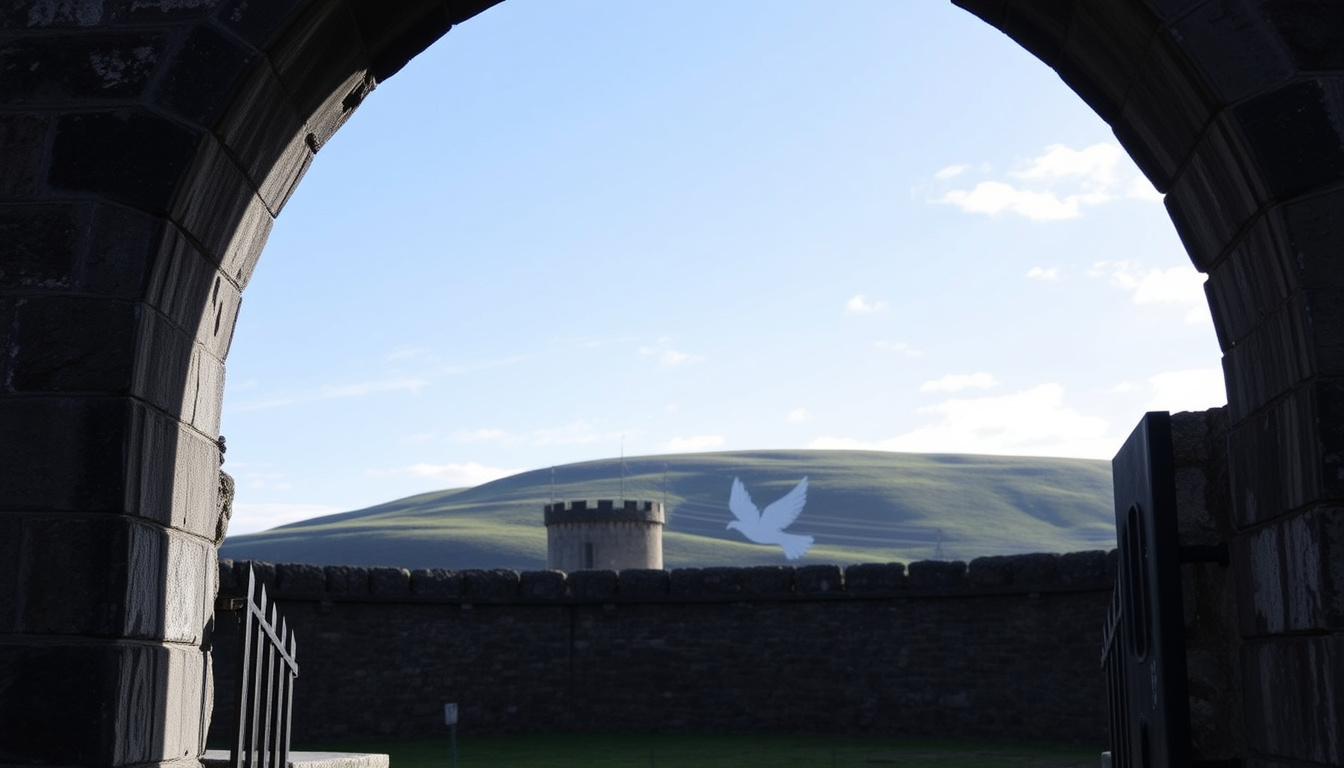
Peace deals don’t often become household names, but the Good Friday Agreement has that kind of staying power. Signed on 10 April 1998 (UK Government official text (GOV.UK)), it brought a formal end to thirty years of sectarian conflict known as the Troubles and created a power-sharing government in Belfast. The essentials — who signed, how the votes went, and who stood in opposition — are all part of the same story: a peace built on compromise.
Year signed: 1998 ·
Referendum turnout (NI): 81% ·
Yes vote (NI): 71% ·
Yes vote (RoI): 94% ·
Conflict length: 30 years (c. 1968–1998)
Quick snapshot
- Peace agreement signed on 10 April 1998 (UK Government) (Encyclopaedia Britannica)
- Ended the Troubles in Northern Ireland (Encyclopaedia Britannica)
- Set up a power-sharing government (Northern Ireland Assembly)
- British and Irish governments (UK Government) (BBC History)
- Most Northern Irish political parties (BBC History)
- Two linked documents: Multi-Party and British-Irish Agreement (NI Assembly Education Service)
- Northern Ireland: 71% yes, 81% turnout (ARK Election Resource)
- Republic of Ireland: 94% yes, 56% turnout (ARK Election Resource)
- Referendums held simultaneously on 22 May 1998 (ARK) (ARK Election Resource)
- Ended 30 years of violence (Britannica)
- Created the Northern Ireland Assembly (NI Assembly)
- Established the consent principle for constitutional change (NI Assembly)
Six key facts that define the Good Friday Agreement, drawn from the official government text and election records.
| Field | Detail |
|---|---|
| Signed date | 10 April 1998 (UK Government) |
| Alternative name | Belfast Agreement (NI Assembly) |
| Type | Peace agreement between two governments and multiple parties (NI Assembly Education Service) |
| Referendums held | 22 May 1998 in both Ireland and Northern Ireland (ARK) |
| Key institutions created | Northern Ireland Assembly, North-South Ministerial Council, British-Irish Council (BBC History) |
| Current status | Still in effect; modified by later agreements e.g. St Andrews 2006 (Britannica) |
What is the Good Friday Agreement in simple terms?
Imagine a peace agreement that had to win the trust of people who had been shooting at each other for a generation. The Good Friday Agreement, signed on 10 April 1998, did exactly that (NI Assembly). It brought a formal close to the Troubles, the 30-year conflict between unionists and nationalists in Northern Ireland (Britannica).
What did the Agreement set up?
- A power-sharing Northern Ireland Assembly and Executive, designed so that both unionist and nationalist communities must cooperate to govern (NI Assembly).
- The North/South Ministerial Council, coordinating policy across the island of Ireland (BBC History).
- The British-Irish Council, linking the UK, Ireland, and the devolved governments (UK Government).
- The “consent principle”: Northern Ireland remains in the UK unless a majority of its people votes otherwise (NI Assembly).
Who were the main parties involved?
The talks were chaired by former US Senator George Mitchell. The British government (led by Tony Blair) and the Irish government (led by Bertie Ahern) drove the process alongside most of Northern Ireland‘s political parties: the Ulster Unionist Party (UUP), the Social Democratic and Labour Party (SDLP), and Sinn Féin (BBC History). The Democratic Unionist Party (DUP) under Ian Paisley walked out and opposed the final deal (NI Assembly Education Service).
The compromise ensured that both communities had a stake in the new institutions.
Why is it called the Good Friday Agreement?
The name comes from the day it was reached: Friday 10 April 1998, which that year fell on Good Friday in the Christian calendar (Britannica). The official legal title is the Belfast Agreement, named after the city where the talks concluded at Stormont (UK Government).
What other name is it known by?
It is formally the Belfast Agreement. The two names are used interchangeably. The UK government’s official publication is titled “The Belfast Agreement,” whereas most media and political commentary uses “Good Friday Agreement” (UK Government).
The dual naming reflects a practical reality: “Good Friday Agreement” carries a hopeful, historical ring, while “Belfast Agreement” sticks to the legal naming convention used in government texts and academic scholarship.
Who signed the Good Friday Agreement?
The Agreement is actually two linked documents: a Multi-Party Agreement between the Northern Ireland political parties, and a British-Irish Agreement between the two sovereign governments (BBC History).
Which governments and political parties signed?
- Government of the United Kingdom — led by Prime Minister Tony Blair (BBC History)
- Government of Ireland — led by Taoiseach Bertie Ahern (BBC History)
- Ulster Unionist Party (UUP) — David Trimble (Nobel Prize)
- Social Democratic and Labour Party (SDLP) — John Hume (Nobel Prize)
- Sinn Féin — Gerry Adams (NI Assembly Education Service)
- Smaller parties including the Alliance Party, Northern Ireland Women’s Coalition, and others.
Who were the key leaders?
Tony Blair and Bertie Ahern were the heads of government. Mo Mowlam, the UK Secretary of State for Northern Ireland, was a crucial figure in rebuilding trust. US Senator George Mitchell chaired the talks, setting the deadlines and mediating the final text (Britannica). David Trimble and John Hume were awarded the 1998 Nobel Peace Prize for their work on the agreement (Nobel Prize).
The broad coalition of signatories gave the Agreement legitimacy, but also left out the most intransigent.
Did Ireland vote in the Good Friday Agreement?
Yes. The entire island of Ireland voted on the Agreement on 22 May 1998, in two concurrent referendums (ARK).
What was the referendum result in the Republic?
The Republic of Ireland voted 94.39% in favour, on a turnout of 56% (ARK). This required a constitutional amendment to remove the Republic’s territorial claim to Northern Ireland and replace it with an aspiration for unity by consent.
What was the referendum result in Northern Ireland?
In Northern Ireland, 71.1% voted Yes, on a turnout of 81% (ARK). The high turnout — exceptional even by local standards — demonstrated an electorate deeply engaged with the decision.
The twin referendums gave the Agreement democratic legitimacy on both sides of the border. No previous settlement attempt had ever received such a direct and simultaneous democratic mandate in both jurisdictions.
The strong democratic mandate on both sides of the border was unprecedented.
Did anyone oppose the Good Friday Agreement?
Yes. Opposition came from both hardline unionists and dissident republicans, though for very different reasons (NI Assembly Education Service).
Which unionist figures opposed it?
The Democratic Unionist Party (DUP), led by Ian Paisley, led the charge. They objected to Sinn Féin entering government without a prior IRA weapons handover. Smaller unionist groups also campaigned for a “No” vote, arguing the agreement weakened the Union (NI Assembly Education Service).
Which republican figures opposed it?
On the republican side, the Real IRA and Continuity IRA rejected the agreement as a sellout of the goal of a united Ireland. They argued that entering Stormont meant accepting partition (BBC History). The Omagh bombing in August 1998, carried out by the Real IRA, was a violent statement of this opposition.
What were their main objections?
- Unionist objection: Paramilitary prisoners were released early and weapons had not been decommissioned before Sinn Féin entered government (NI Assembly Education Service).
- Republican objection: The Agreement explicitly affirmed Northern Ireland’s place in the UK until a majority votes otherwise, and it required taking seats in a “British” parliament (BBC History).
The opposition, though vocal, was ultimately unable to derail the peace process. The republican objection stemmed from the Agreement’s affirmation of Northern Ireland’s place in the UK and the requirement to take seats in a “British” parliament, a stance that can be further explored through the BBC Radio 4 live stream.
Timeline: How the Good Friday Agreement came together
The journey from conflict to agreement spanned decades and reached its critical phase in the final months of 1997 and early 1998.
- 1968–1998: The Troubles — three decades of sectarian violence, political stalemate, and failed initiatives (Britannica)
- 10 April 1998: Good Friday Agreement signed at Stormont, Belfast (Britannica)
- 22 May 1998: Simultaneous referendums approve the Agreement in NI (71% Yes) and RoI (94% Yes) (ARK)
- 1 July 1998: First election to the new Northern Ireland Assembly (ARK)
- 2 December 1999: Power-sharing executive officially formed (BBC History)
- 2006: St Andrews Agreement revises and strengthens the original institutions (Britannica)
This sequence shows how the Agreement moved from negotiation to implementation over two years.
Confirmed facts vs. what remains unclear
Confirmed facts
- The Good Friday Agreement was signed on 10 April 1998 (UK Government)
- It includes two documents: a Multi-Party Agreement and a British-Irish Agreement (NI Assembly)
- Referendums on both sides of the border approved it (ARK)
- The DUP and smaller unionist parties opposed it (NI Assembly Education Service)
- Sinn Féin signed the Agreement (BBC History)
What’s unclear
- The exact number of dissident republican signatories to the full document is debated.
- Some academic sources debate whether the Agreement is a single “constitutional moment” or a long-term process (Fordham International Law Journal).
- The long-term impact of post-Brexit tensions on the consent principle remains uncertain.
- Whether the Agreement’s institutions can survive indefinitely without a functioning executive is an open question.
- The precise number of former paramilitary members who genuinely abandoned violence remains subject to academic dispute.
- How the devolved settlement will adapt to the changing demographic balance between unionists and nationalists is a topic of ongoing analysis.
The clarity of the confirmed facts contrasts with the open questions that still surround the Agreement’s future.
Voices from the negotiations
“The Agreement rests on the principle of consent: Northern Ireland’s constitutional status cannot change without a majority vote of its people. That principle is the bedrock of everything we built.” — Tony Blair, UK Prime Minister at the time of the Agreement (UK Government)
“The cross-border institutions were not an afterthought — they were central to the entire architecture. We made sure nationalists could see themselves in a new Ireland, while unionists saw their place in the UK protected.” — Bertie Ahern, Irish Taoiseach (BBC History)
“We set a deadline. Everyone thought we were bluffing. But the deadline forced the parties to make the final choices that created the Agreement.” — Senator George Mitchell, talks chair (Britannica)
“The Agreement let people out of prison before they gave up their weapons. It rewarded violence with a seat at the table. We could not support that.” — Ian Paisley, DUP leader opposing the 1998 deal (NI Assembly Education Service)
These perspectives illustrate the deep divisions that the Agreement tried to bridge.
The legacy of the Good Friday Agreement
Twenty-five years on, the Good Friday Agreement remains the constitutional anchor for Northern Ireland’s government. It has suspended several times, survived the rise of the DUP and Sinn Féin as the largest parties, and weathered the seismic shock of Brexit. The agreement does not guarantee harmony — it guarantees that disagreement must be managed through shared institutions, not violence. For anyone in Northern Ireland today, the choice embedded in the Agreement is still the one that matters: work within the system, or let the system collapse back into direct rule from London.
Related reading: Great Limerick Run 2026 · Ireland v All Blacks – New Zealand Wins 23-13 in Dublin
Frequently asked questions
What is the difference between the Good Friday Agreement and the Belfast Agreement?
There is no difference. “Good Friday Agreement” is the popular name, referring to the day it was signed. “Belfast Agreement” is the official legal name used in government publications.
How long did the Good Friday Agreement take to negotiate?
The formal multi-party talks began in June 1996 and concluded on 10 April 1998, but the peace process leading to those talks stretched back through the 1980s and early 1990s (Britannica).
Was the Good Friday Agreement a treaty?
It has elements of both a domestic political agreement (the Multi-Party Agreement) and an international treaty (the British-Irish Agreement), registered with the United Nations.
Does the Good Friday Agreement guarantee a united Ireland?
No. It establishes the consent principle: Northern Ireland remains in the UK unless and until a majority of its population votes otherwise. If a border poll returned a majority for unity, both governments are committed to legislation enabling it.
What happened to prisoners under the Good Friday Agreement?
The Agreement provided for the early release of paramilitary prisoners belonging to organizations observing a ceasefire. Over 400 prisoners were released within two years (UK Government).
Is the Good Friday Agreement still in force today?
Yes. The institutions were suspended several times (most recently in 2022–2024) but the Agreement itself remains the constitutional framework for Northern Ireland. It has been supplemented by the St Andrews Agreement (2006) and other accords.
What is Strand One, Strand Two, and Strand Three?
The Agreement is organized into three “strands”: Strand One covers the Northern Ireland Assembly and Executive (internal governance); Strand Two covers the North/South Ministerial Council (cross-border cooperation); Strand Three covers the British-Irish Council and British-Irish Intergovernmental Conference (east-west relations).
These FAQs address common points of confusion about the Agreement’s structure and status.