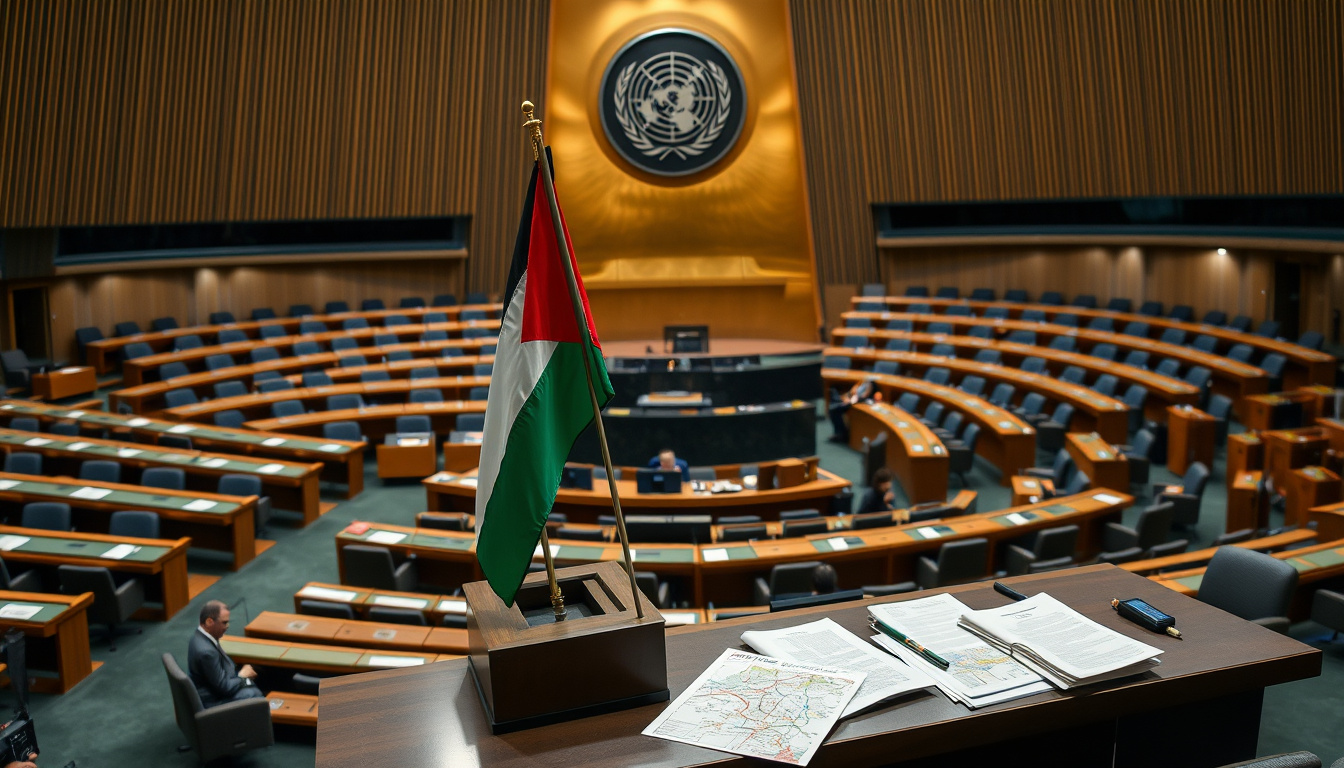
Few questions in geopolitics spark as much confusion and debate as whether Palestine is a country. The answer isn’t a simple yes or no — while 146 UN member states recognize a Palestinian state, the United Nations itself lists Palestine as a “non-member observer state,” not a full member. This article unpacks the legal status, historical timeline, and diplomatic recognition to help you understand where Palestine stands under international law.
UN observer status: Non-member observer state since 2012 ·
Countries recognizing Palestine: 146 of 193 UN member states ·
Territorial claims: West Bank, Gaza Strip, East Jerusalem ·
UNESCO membership: Full member since 2011
Quick snapshot
- Palestine declared statehood in 1988 (Encyclopaedia Britannica (reference work))
- 146 UN members recognize the State of Palestine as of May 2024 (OHCHR (UN human rights office))
- UN non-member observer state since 2012 (UN News (official UN news service))
- Whether Palestine fully meets the Montevideo Convention criteria for statehood (EJIL: Talk! (international law blog))
- Whether East Jerusalem functions as the de facto capital (Council on Foreign Relations (US think tank))
- Whether Gaza is under effective government control (UN News (official UN news service))
- 1920-1948: British Mandate for Palestine (Encyclopaedia Britannica)
- 1947: UN Partition Plan proposes Arab and Jewish states (Encyclopaedia Britannica)
- 1988: PLO declares State of Palestine (Encyclopaedia Britannica)
- 2012: UN grants non-member observer state status (UN News)
Six key facts define Palestine’s current standing internationally: from its official name to administrative center.
| Field | Value |
|---|---|
| Official name | State of Palestine |
| Declaration of statehood | 1988 (PLO) |
| UN observer status | 2012 |
| Capital claim | East Jerusalem |
| Administrative center | Ramallah |
| Population | Approximately 5.5 million |
Is Palestine a country yes or no?
What is the official status of Palestine?
The State of Palestine is recognized by 146 of 193 UN member states as of 28 May 2024, according to UN experts (OHCHR, UN human rights office). That’s more than three-quarters of the UN membership. Yet the United Nations itself classifies Palestine as a “non-member observer state,” a status it acquired in 2012 (UN News, official UN news service). This means Palestine can participate in UN debates but cannot vote on draft resolutions in the main organs.
So the short answer: it depends on whom you ask. For 146 countries, yes — Palestine is a country. For the United States, the United Kingdom, Germany, France, and several others, it is not a fully recognized sovereign state.
Does Palestine meet the criteria for statehood?
The 1933 Montevideo Convention on the Rights and Duties of States defines a state as having: a permanent population, a defined territory, a government, and the capacity to enter relations with other states. Palestine has a permanent population of about 5.5 million people and claims the West Bank, Gaza Strip, and East Jerusalem as its territory. The Palestinian Authority governs parts of the West Bank, while Hamas controls Gaza — raising questions about unified government control. Capacity to enter relations? Palestine maintains diplomatic missions in over 90 countries. According to EJIL: Talk! (international law blog), it can reasonably be argued that Palestine does not meet the Montevideo criteria fully because of undefined borders and divided governance.
Bottom line: Palestine meets three of four Montevideo criteria but struggles with the government criterion due to the Hamas-PA split. For the 146 recognizing states, that is enough. For non-recognizing states, it is not.
The implication: Statehood is partly a legal question and partly a political decision. The facts on the ground matter less than the diplomatic will to recognize them.
Is Palestine a country legally?
What does international law say about Palestinian statehood?
International law does not provide a single answer. The Montevideo Convention sets the most widely used criteria, but recognition remains a discretionary act of states. The 2012 UN General Assembly resolution granting Palestine non-member observer state status can be understood, according to EJIL: Talk! (international law blog), as an act of collective recognition of Palestinian statehood. Yet that interpretation is contested. The upgrade allowed Palestine to join the International Criminal Court and other treaties, giving it legal standing that observer organizations lack.
What is the Montevideo Convention criteria?
The four criteria are permanent population, defined territory, government, and capacity to enter foreign relations. Palestine has a permanent population and engages in foreign relations (bilateral recognition, UN participation). Its territory is disputed but defined in the Oslo Accords. The government criterion is the weak point: the Palestinian Authority controls roughly 40% of the West Bank, while Hamas governs Gaza independently (Council on Foreign Relations, US think tank).
Palestine behaves like a state — it issues passports, joins treaties, and fields diplomats — but lacks the universal recognition that would make its statehood undisputed.
Why this matters: Legal uncertainty means Palestinian institutions cannot rely on a consistent body of international law to protect their claims, while Israeli settlements and military operations face different legal standards depending on who is judging.
Why is Palestine not recognized as a country?
Which countries do not recognize Palestine?
The United States, Canada, the United Kingdom, Germany, France, Australia, Japan, South Korea, and most of Latin America are among the notable non-recognizers. The 2012 UN vote saw 9 states vote against: the United States, Canada, Israel, Czech Republic, Micronesia, Marshall Islands, Nauru, Palau, and Panama (UN News). Many European nations maintain diplomatic missions to the Palestinian Authority but stop short of full recognition.
What are the main obstacles to recognition?
Three obstacles dominate:
- Border disputes: The exact borders of a Palestinian state are unresolved, with Israeli settlements and the separation wall altering the West Bank’s geography.
- Hamas control of Gaza: The split between Fatah-led Palestinian Authority in the West Bank and Hamas in Gaza undermines the claim of a unified government.
- Lack of mutual recognition with Israel: Israel does not recognize a Palestinian state, and the Oslo Accords left final status issues (borders, Jerusalem, refugees) unresolved.
Additionally, UN Security Council veto power blocks full membership. The United States has signaled it would veto any application (Council on Foreign Relations).
The trade-off: Without recognition from major Western powers, Palestine struggles to access international trade agreements, secure loans from institutions like the IMF, and protect its citizens under international law.
Was Palestine a country before Israel?
What was the region called before 1948?
The area historically known as Palestine was under the British Mandate from 1920 to 1948. Before that, it was part of the Ottoman Empire for four centuries. The term “Palestine” has ancient roots — the Roman province of Syria Palaestina — but no independent Palestinian state existed in the modern sense before 1948. The 1947 UN Partition Plan proposed separate Arab and Jewish states, but the Arab side rejected it, leading to the 1948 Arab-Israeli war (Encyclopaedia Britannica).
Who controlled the territory historically?
After the Ottoman collapse, Britain administered the mandate. In 1947, the UN proposed partition. Israel declared independence in 1948, and Jordan occupied the West Bank while Egypt held Gaza. In 1967, Israel captured both territories in the Six-Day War and has occupied them since (Council on Foreign Relations).
The pattern: The lack of a historical Palestinian state has been used by opponents of recognition to argue that statehood is a recent political invention. Proponents counter that many modern states emerged after decolonization in the 20th century.
Is Palestine a country in the UN?
What is non-member observer state status?
Non-member observer state status was granted to Palestine by UN General Assembly resolution 67/19 on 29 November 2012, with 138 votes in favor, 9 against, and 41 abstentions (UN News). This status allows Palestine to participate in UN proceedings, sign treaties, join specialized agencies (like UNESCO, which it joined in 2011), and speak in debates, but it cannot vote on draft resolutions in the General Assembly or Security Council.
Can Palestine become a full UN member?
Full membership requires a recommendation from the UN Security Council (with no veto from the permanent five) followed by a two-thirds majority vote in the General Assembly. The United States has consistently stated it would veto any Palestinian membership bid. In April 2024, the Security Council voted on a resolution recommending membership — it received 12 votes in favor but was vetoed by the United States (UN News).
What this means: Palestine’s UN status is stuck in a middle tier — more than an observer organization, less than a full member. The upgrade in 2012 gave it legal standing to join the International Criminal Court and the Geneva Conventions, but the veto ceiling remains the hardest barrier.
Timeline: Palestine’s path to statehood
- – British Mandate for Palestine established
- – UN Partition Plan proposes Arab and Jewish states (UN News)
- – State of Israel declared; Arab-Israeli war begins
- – Six-Day War; Israel occupies West Bank, Gaza, East Jerusalem
- – Palestine Liberation Organization granted UN observer status (CFR)
- – PLO declares State of Palestine (Britannica)
- – Oslo Accords establish Palestinian Authority
- – Palestine joins UNESCO as full member (UN News)
- – UN grants non-member observer state status
The catch: Each milestone has been a partial victory — more rights without full membership. The 1988 declaration was symbolic; the 2012 upgrade gave legal teeth; but full sovereignty remains out of reach.
What we know and what remains uncertain
Confirmed facts
- Palestine declared statehood in 1988 and is recognized by 146 UN members (OHCHR)
- UN non-member observer state since 2012 (UN News)
- Palestinian Authority governs parts of West Bank (CFR)
- East Jerusalem claimed as capital; Ramallah is administrative center
What’s unclear
- Whether Palestine meets all Montevideo criteria for statehood (EJIL: Talk!)
- Whether East Jerusalem is the de facto capital (CFR)
- Whether Gaza is under effective government control
- Whether the 2012 UN resolution represents collective recognition of statehood (EJIL: Talk!)
Perspectives on statehood
The 2012 resolution can be understood as an act of collective recognition of Palestinian statehood.
— EJIL: Talk! (international law blog)
Palestine’s status as a Permanent Observer State at the UN allows it to participate in all UN proceedings except voting on draft resolutions and decisions in the main UN organs.
— UN News
Summary
Palestine sits in a gray zone of international law: recognized by a clear majority of UN members but denied full membership by great-power politics and unresolved conflicts on the ground. For the 146 states that recognize it, Palestine is a country with legal personality and a seat at the table. For the United States and other holdouts, it remains a non-sovereign entity with contested borders and divided governance. For Americans watching the debate, the distinction matters: depending on which definition you use, Palestine either is or isn’t a country — and that ambiguity shapes policy, aid, and diplomacy in the Middle East. The catch: nearly three-quarters of UN members have decided that Palestine meets the bar for statehood, yet the permanent members who withhold recognition continue to block its full integration into international institutions.
nyujilp.org, en.wikipedia.org, unric.org, ejiltalk.org, bbc.com, en.wikipedia.org, betterworldcampaign.org
For a detailed historical perspective on the same question, see the analysis of Palestine’s Status, Recognition, and History.
Frequently asked questions
Is Palestine a country in the UN?
No, Palestine is a non-member observer state, not a full member. It can participate in UN proceedings but cannot vote on most resolutions.
How many countries recognize Palestine?
146 out of 193 UN member states recognize the State of Palestine as of May 2024.
What is the capital of Palestine?
Palestine claims East Jerusalem as its capital, but its administrative center is in Ramallah.
Does Palestine have a government?
Yes, the Palestinian Authority governs parts of the West Bank, while Hamas controls the Gaza Strip, forming a divided governance structure.
What territory does Palestine claim?
The West Bank, Gaza Strip, and East Jerusalem. Borders are disputed and not fully defined.
Why doesn’t the US recognize Palestine?
The US considers Palestinian statehood a final-status issue to be resolved through direct negotiations with Israel. It also cites lack of defined borders and Hamas control of Gaza.
Can Palestine become a full UN member?
Theoretically yes, but it requires a Security Council recommendation without a veto. The US has vetoed past attempts and signaled it would do so again.
Is Palestine on the map?
Yes, Palestine appears on many maps, especially those published by recognizing states. Google Maps shows the West Bank and Gaza Strip as Palestinian territories, but the borders are not universally agreed.
Related reading
- Understanding Palestine’s UN observer status and international recognition
- Palestine non-member observer state status explained