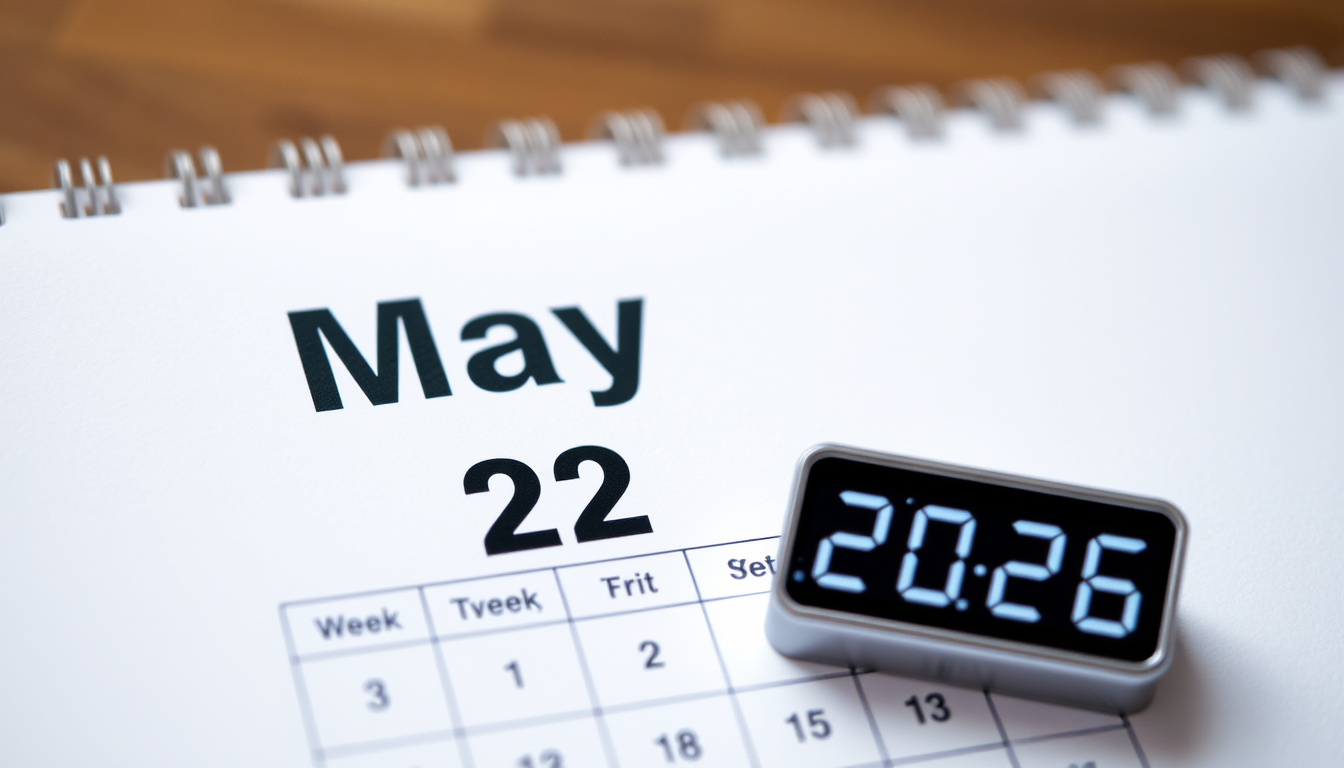
Wondering what week of the year it is? As of May 28, 2026, we’re in week 22 of a year that holds a quirk: 2026 has 53 weeks under the ISO 8601 standard.
Current week number: Week 22 ·
Total weeks in 2026: 53 ·
Is 2026 a leap year? No ·
ISO 8601 standard used: Yes ·
Days elapsed in 2026: 148 of 365 ·
Weeks remaining: 31
Quick snapshot
- Current week is 22 (May 25–31) (Epoch Converter)
- 2026 has 53 ISO weeks (Calendar.best)
- 2026 is not a leap year (Epoch Converter)
- How many organisations adjust payroll for week 53
- Which cultures still use non-7-day weeks today
- Jan 1, 2026 – Thursday, ISO week 1 starts Dec 29, 2025
- May 28, 2026 – Week 22
- Dec 31, 2026 – Thursday, week 53 ends Jan 3, 2027
- Week 23 starts Monday, June 1, 2026
- Payroll and forecasting systems may need to handle 53 periods
The following table presents the key facts about the current date and week numbering system.
| Fact | Value |
|---|---|
| Current date | May 28, 2026 |
| Current week number | 22 |
| Total weeks in year | 53 |
| Days elapsed | 148 |
| Leap year? | No |
| ISO week standard | ISO 8601 |
What week is it right now?
According to the ISO 8601 week date system, the current week is week 22 of 2026. This week runs from Monday, May 25 through Sunday, May 31, as verified by multiple week-number tools (Epoch Converter, Calendar.best).
Current week number for 2026
The ISO week date system, issued by the International Organization for Standardization (Wikipedia – ISO week date), defines weeks starting on Monday. Week 22 of 2026 corresponds to day 148 of the year.
How to check the week number today
- Visit Epoch Converter’s week number page – it shows the current week in real time.
- Search “week number” in your preferred search engine – most show an instant answer.
Why will 2026 have 53 weeks?
Most years have 52 weeks, but 2026 is one of the exceptions. The reason lies in how the ISO week system defines the first week of the year.
How the ISO week system creates a 53rd week
Under ISO 8601, week 1 is the week containing the year’s first Thursday (Wikipedia – first Thursday rule). Equivalent: it’s the week containing January 4 (Caesar Cipher – week number guide). If January 1 falls on a Thursday, that week counts as week 1 of the new year — but the previous year’s last week may extend into the new year.
In 2026, January 1 is a Thursday. That means:
- Week 1 of 2026 actually begins on Monday, December 29, 2025.
- Because the year starts on Thursday, the last day of 2026 (also a Thursday) falls in a 53rd week.
Calendar year vs. ISO year boundaries
The ISO week year can differ from the calendar year. The Thursday rule means that a few days at the start or end of a calendar year may belong to the adjacent ISO year. For 2026, the ISO year has 53 weeks because the calendar year has 365 days but the extra day (Thursday start) pushes the final week count to 53 (Calendar.best).
Is 2026 a leap year or not?
No, 2026 is not a leap year. The Gregorian calendar rules are clear.
Leap year rules: Gregorian calendar
A year is a leap year if it is divisible by 4, except for century years not divisible by 400. 2026 is not divisible by 4, so it has 365 days.
Why 2026 is not a leap year
2026 ÷ 4 = 506.5, not an integer. Therefore February has 28 days, and the total days remain 365. The next leap year after 2024 is 2028.
Are there cultures that don’t use a 7-day week?
The 7-day week is dominant worldwide, but it’s not the only system that has existed.
Non-Gregorian calendar systems
- Ancient Rome: Used an 8-day market week (nundinae).
- France: During the French Revolution, a 10-day week (décade) was official from 1793 to 1805.
- Soviet Union: Experimented with a 5-day week in 1929–1931 for industrial shifts.
- Bali: The Pawukon calendar has a 210-day cycle with weeks of varying length (1 to 10 days).
These historical alternatives show that the 7-day cycle is a convention, not a law of nature.
Historical variations in week length
Today, the 7-day week is nearly universal for civil and business purposes, thanks to global standardisation and the influence of Abrahamic religions. However, traditional and religious calendars in some regions (e.g., the Balinese calendar or the Islamic calendar) maintain different rhythms alongside the Gregorian week.
Just because the 7-day week is standard doesn’t mean it’s universal. When working with international teams, be aware that some colleagues may operate on a different weekly rhythm for cultural or religious observances.
What week of the year is it tomorrow?
If today is Thursday, May 28, 2026 (week 22), tomorrow is Friday, May 29. Since week numbers only change on Monday, tomorrow remains week 22.
Predicting future week numbers
Week numbers advance every Monday. To find the week number for a future date, subtract the ordinal day of the year from the weekday index, add 10, divide by 7, and handle edge cases (Wikipedia – ISO week calculation).
Week number shift: today vs. tomorrow
Because ISO weeks run Monday–Sunday, any day from Monday to Sunday belongs to the same week number. So May 29 (Friday) is still week 22. Week 23 begins on Monday, June 1.
What’s the current week number?
We’ve established it’s week 22. But what tools provide instant verification?
Using Epoch Converter and other tools
- Epoch Converter (week number calculator) – shows current week, past dates, and future dates.
- Time.now (week number tool) – real-time week number display.
- General Blue (week number calculator) – allows picking any date.
Week number calculators overview
Most calculators follow ISO 8601 by default. Some allow switching to US week numbering (Sunday start). Always check which standard your tool uses to avoid confusion.
For a quick answer, the Epoch Converter tool is reliable and authoritative. For Excel users, the ISOWEEKNUM() function returns the ISO week number directly.
Why do we need a week 53?
Week 53 occurs when the ISO year has 53 weeks. This happens roughly every 5–6 years. Its impact is felt in financial planning, payroll, and forecasting.
Planning and payroll implications
Years with 53 weeks can create an extra pay period for employees paid weekly or bi-weekly. Companies using 52-period accounting must adjust to accommodate the extra week. Forecasting models that assume 52 weeks may misalign with actual dates.
Forecasting software and annual schedules
Many enterprise resource planning (ERP) systems support 53-period years (e.g., SAP, Oracle). But smaller organisations may need to manually adjust. Always check your fiscal calendar when 2026 approaches.
ISO week date specification
Six key fields define how ISO 8601 structures the week date system — here’s a quick reference table.
| Component | Format / Rule | Example (2026-W22-4) |
|---|---|---|
| Week year | 4-digit year, may differ from calendar year | 2026 |
| Week number | 01–53, prefixed by W | W22 |
| Weekday | 1 (Monday) to 7 (Sunday) | 4 (Thursday) |
| Full format | YYYY-Www-d | 2026-W22-4 |
| Week start | Monday | May 25 |
| Week end | Sunday | May 31 |
The pattern here is that each component builds on the previous one to create a precise, unambiguous date.
How to find the week number for any date
You don’t need a special tool — here’s a manual method plus software shortcuts.
- Determine the ordinal day of the year (e.g., May 28 = day 148).
- Find the weekday index (Monday=1 … Sunday=7).
- Apply the formula: week = floor((ordinal – weekday + 10) / 7).
- If the result is 0, the date belongs to week 53 of the previous year. If the result is 53, check whether the year truly has 53 weeks.
Using spreadsheets and online calculators
- Excel: Use
ISOWEEKNUM(date)for ISO weeks. For older versions,WEEKNUM(date,21)(Epoch Converter – Excel guidance). - Google Sheets:
WEEKNUM(date,1)for Monday-start ISO-like system (but double-check with 21 for strict ISO). - Online: Use the Epoch Converter week number tool or General Blue.
Edge cases to watch
- Early January: days before the first Thursday belong to week 53 of the previous year.
- Late December: days after the last Thursday may belong to week 1 of the next year.
Week 22 and beyond: key dates in 2026
- January 1, 2026 – Year starts on Thursday; ISO week 1 begins on December 29, 2025 (Calendar.best)
- May 28, 2026 – Current date: week 22, day 148
- December 31, 2026 – Year ends on Thursday; ISO week 53 ends on January 3, 2027 (Calendar.best)
What we know and what remains unclear
Confirmed facts
- 2026 has 53 weeks under ISO 8601 (Calendar.best)
- 2026 is not a leap year
- May 28, 2026 is week 22 (Epoch Converter)
What’s unclear
- Exactly how many organisations adjust payroll for week 53
- Which cultures still use non-7-day weeks today
“ISO Week 1 is the week containing the year’s first Thursday, equivalently the week containing January 4.”
Wikipedia – ISO week date (definition)
“Week 22 of 2026 runs from Monday, 2026-05-25 through Sunday, 2026-05-31.”
Epoch Converter (week number verification)
For planners and payroll managers in 2026, the key takeaway is that week 53 is not a theoretical edge case — it’s a calendar reality that will affect annual schedules. Those who prepare early can avoid surprises in December.
If you prefer Dutch sources, huidig weeknummer en kalender provides the same current week information with a full calendar overview.
Frequently asked questions
What is the current week number?
As of May 28, 2026, the ISO week number is 22. This week runs from May 25 to May 31.
How is the week number calculated?
The ISO week number is calculated by taking the ordinal day of the year, subtracting the weekday index, adding 10, dividing by 7, and handling edge cases where the result is 0 or 53.
What is ISO 8601?
ISO 8601 is the international standard for date and time representation. It defines the week date system with Monday as the first day of the week and week 1 as the week containing the first Thursday of the year.
Why does 2026 have 53 weeks?
Because January 1, 2026 is a Thursday. Under the first Thursday rule, week 1 begins on December 29, 2025, and the year ends with a full 53rd week.
Is 2026 a leap year?
No. 2026 is not divisible by 4, so February has 28 days and the year has 365 days.
How do I find the week number for any date?
Use online tools like Epoch Converter, calculate manually with the formula, or use Excel’s ISOWEEKNUM() function.
Do all countries use the same week numbering system?
Most countries use ISO 8601 for civil purposes, but the United States often uses a Sunday-start week and a slightly different numbering system. Always confirm which standard applies in your context.
Related reading