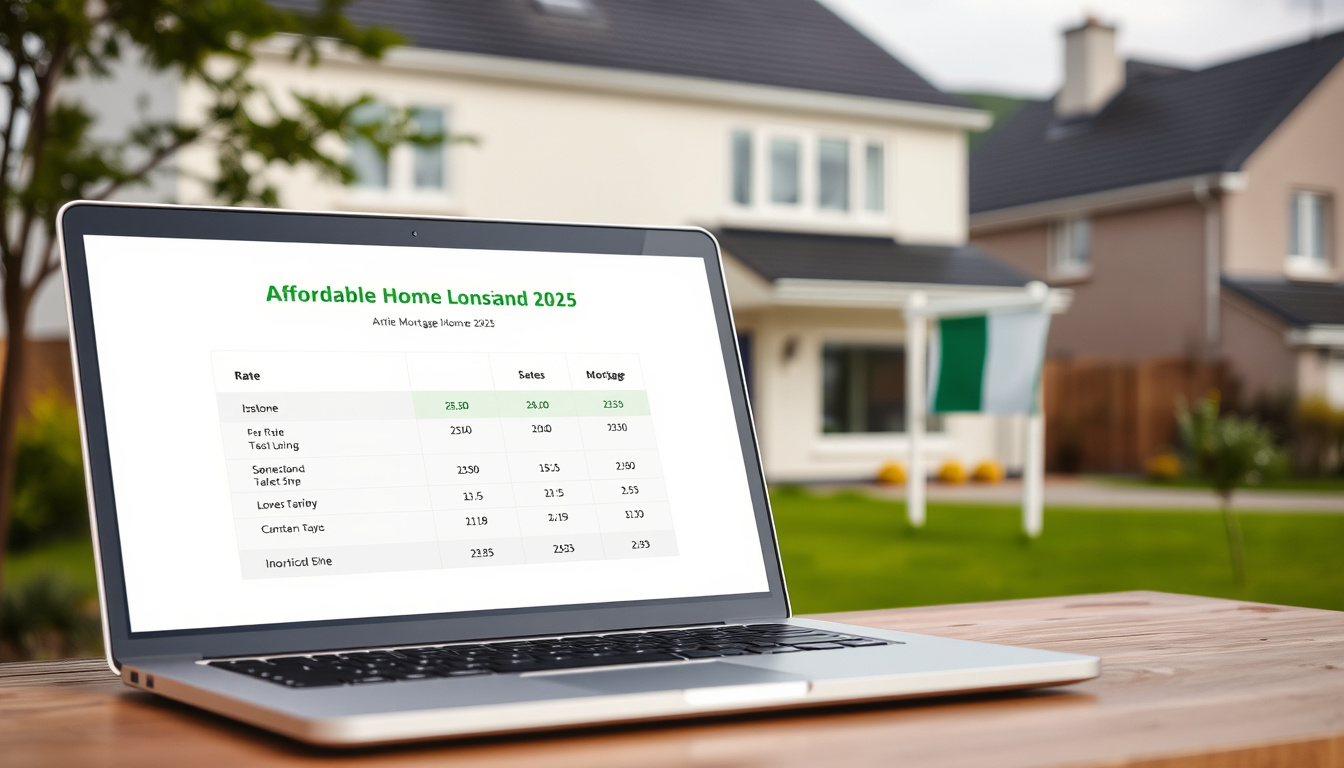
Ireland’s mortgage rates have finally converged with the eurozone average after years of disparity. A full year of European Central Bank (ECB) rate cuts has brought the average new Irish mortgage rate to 3.48%, matching the eurozone average for the first time since early 2022.
Current average mortgage rate (eurozone average)3.48%Lowest fixed rate available3.0%Competitive fixed rate from Avant3.20%Best variable rate3.75%
| Metric | Value |
|---|---|
| Current lowest fixed rate | 3.0% (doddl.ie) |
| Current lowest variable rate | 3.75% |
| Average new mortgage rate | 3.48% |
| Typical maximum age at term end | 70 years |
| Typical maximum mortgage term | 30 years |
Current Lowest Rates
- Fixed from doddl.ie: 3.0%
- Variable from AIB (LTV ≤50%): 3.75%
- Avant Money fixed: 3.20%
Rate Trends
- Average new mortgage rate: 3.48% (eurozone equal, per Switcher.ie)
- ECB cuts driving decline
- Forecasts for further drops into 2026
Fix vs Variable
- 2-year fix ~3.5%
- 5-year fix ~3.75%
- Variable ~3.75%
Age & Pensioner
- Max age at term end usually 70
- Some lenders accept up to 75
- Pension income considered
Who has the lowest mortgage rate at the moment?
The cheapest fixed-rate mortgage currently available in Ireland is 3.0% from doddl.ie. Avant Money offers a competitive fixed rate of 3.20% as stated on the Avant Money website. For variable rates, AIB offers the lowest at 3.75% for loan-to-value up to 50%, per AIB’s published rates.
Which bank offers the best loans?
Comparing the overall package, AIB’s variable at 3.75% and doddl.ie’s fixed at 3.0% stand out. For switchers, the average rate reported by Switcher.ie is 3.48%, matching the eurozone average. EBS variable is 4.15% and its 1-year fixed is 3.85% per EBS.
Pros of current low rates
- Fixed rates at 3.0% offer certainty and savings
- Variable from 3.75% gives flexibility
Cons
- Best fixed rates require low LTV or green criteria
- Variable rates are still above eurozone average for many lenders
Are Irish mortgage rates coming down?
Yes. The ECB’s rate-cutting cycle, which began in late 2024, has driven Irish rates lower. The average new mortgage rate dropped from 3.77% in March 2025 to 3.50% by December 2025, according to the Central Bank of Ireland. Many analysts predict further cuts, with 3% rates possibly returning within two years. “Irish mortgage rates have dropped to 3.48%, matching the eurozone average for the first time in over three years,” said a Switcher.ie spokesperson.
What are the best mortgage rates in Ireland for 2026?
Forecasts suggest the ECB will continue cutting, potentially bringing the average fixed rate below 3.2%. Already, Avant Money offers a fixed rate of 3.20%.
Will interest rates be 3% again?
It’s plausible within 12–24 months if inflation remains controlled. The current lowest rate of 3.0% shows the market can sustain sub-3% fixed deals.
Should I fix for 2 or 5 years?
Short-term fixes (2-year) currently average around 3.5%, while 5-year fixes average about 3.75%. Variable rates start at 3.75%. Locking in now protects against potential rate increases, but if ECB cuts accelerate, you could miss lower rates. Conversely, a variable rate gives flexibility but no long-term certainty.
What is the difference between fixed and variable rates in Ireland?
Fixed rates freeze your monthly payment for a set term; variable rates fluctuate with market conditions. A 2-year fix is ideal for those expecting to switch or sell soon; a 5-year fix suits long-term stability seekers. Variable rates may drop faster when ECB cuts hit, but they can also rise.
What is the oldest age you can get a mortgage at?
Most lenders require the mortgage to be repaid by age 70. Some lenders, like Avant Money, may extend to age 75 if you can demonstrate sustainable pension income. Loan terms are shorter for older borrowers — often capped at 20 years.
Can a 70 year old get a 20 year mortgage?
Unlikely from mainstream banks, as the term would extend to age 90. However, some specialist lenders or credit unions may consider it with strong pension proof.
What’s the oldest age you can get a 30 year mortgage?
In practice, you need to be under 40 to secure a 30-year term with most lenders. By age 40, terms are often limited to 25 years.
What is the oldest age you can get a loan?
For mortgages, the maximum age at loan maturity is typically 70, though a few lenders go to 75. For smaller personal loans, limits are even tighter.
Is 40 too old to get a 30 year mortgage?
Yes, because the term would end at 70. Most lenders would not approve a 30-year term for a 40-year-old applicant.
Can a pensioner apply for a loan?
Yes. Many lenders accept pension income as a valid income source, but age limits still apply (usually mortgage must end by age 70). Pensioners can borrow smaller amounts over shorter terms. Specialist lenders may offer products for borrowers aged up to 75.
Which banks offer mortgages to pensioners in Ireland?
Bank of Ireland, AIB, and Avant Money consider pension income. Avant Money, for instance, states on its site that it accepts pension as income. However, approval depends on affordability and remaining term.
“Competitive fixed mortgage interest rates from 3.20%” — Avant Money website
“Irish mortgage rates have dropped to 3.48%, matching the eurozone average for the first time in over three years.” — Switcher.ie spokesperson
Mortgage Rate Comparison Table
Here’s a snapshot of the lowest current rates from major lenders.
| Lender | Product | Rate | APRC |
|---|---|---|---|
| doddl.ie | 2-Year Fixed | 3.0% | 3.78% |
| Avant Money | 3-Year Fixed | 3.20% | 3.95% |
| AIB | Variable (LTV ≤50%) | 3.75% | 4.05% |
| EBS | 1-Year Fixed | 3.85% | 4.10% |
Related reading: Bord Gáis Dual Fuel: Compare Plans & Save in 2025 · Gas and Electricity Comparison Ireland 2025: Cheapest Suppliers
mortgagewatch.ie, mfcu.ie, getsortd.ie, doddl.ie, centralbank.ie, centralbank.ie, centralbank.ie, centralbank.ie
Frequently Asked Questions
What are the best mortgage rates for first-time buyers in Ireland?
First-time buyers often qualify for green mortgage rates from AIB (from 3.30% fixed for 1-year LTV ≤50%) and Avant Money (3.20% fixed). The lowest variable for FTBs is AIB at 3.75%.
How do I switch mortgage lender to get a lower rate?
You can switch to a lender like doddl.ie or Avant Money. The process takes 6–12 weeks and involves a new valuation, legal fees, and credit check. The potential savings from dropping from 4% to 3% can be substantial.
Do Irish banks offer cashback on mortgages?
Some lenders, like AIB and Bank of Ireland, offer cashback (typically 2% of the mortgage amount) for switchers. Always compare the net rate after cashback.
What is the current ECB interest rate and how does it affect mortgage rates?
The ECB main refinancing rate is currently 2.75% (as of early 2025). These cuts directly influence variable rates and new fixed rates, though Irish banks don’t always pass them on immediately.
How long does it take to get a mortgage approved in Ireland?
Approval in principle can take 1–2 weeks; full approval after finding a property typically takes 4–8 weeks. Some lenders offer fast-track pre-approval.
Are there any mortgages with no early repayment charges in Ireland?
Variable rate mortgages and a few fixed-rate products (e.g., from Avant Money) may allow up to 10% overpayment per year without penalty, but full early repayment incurs ERCs.