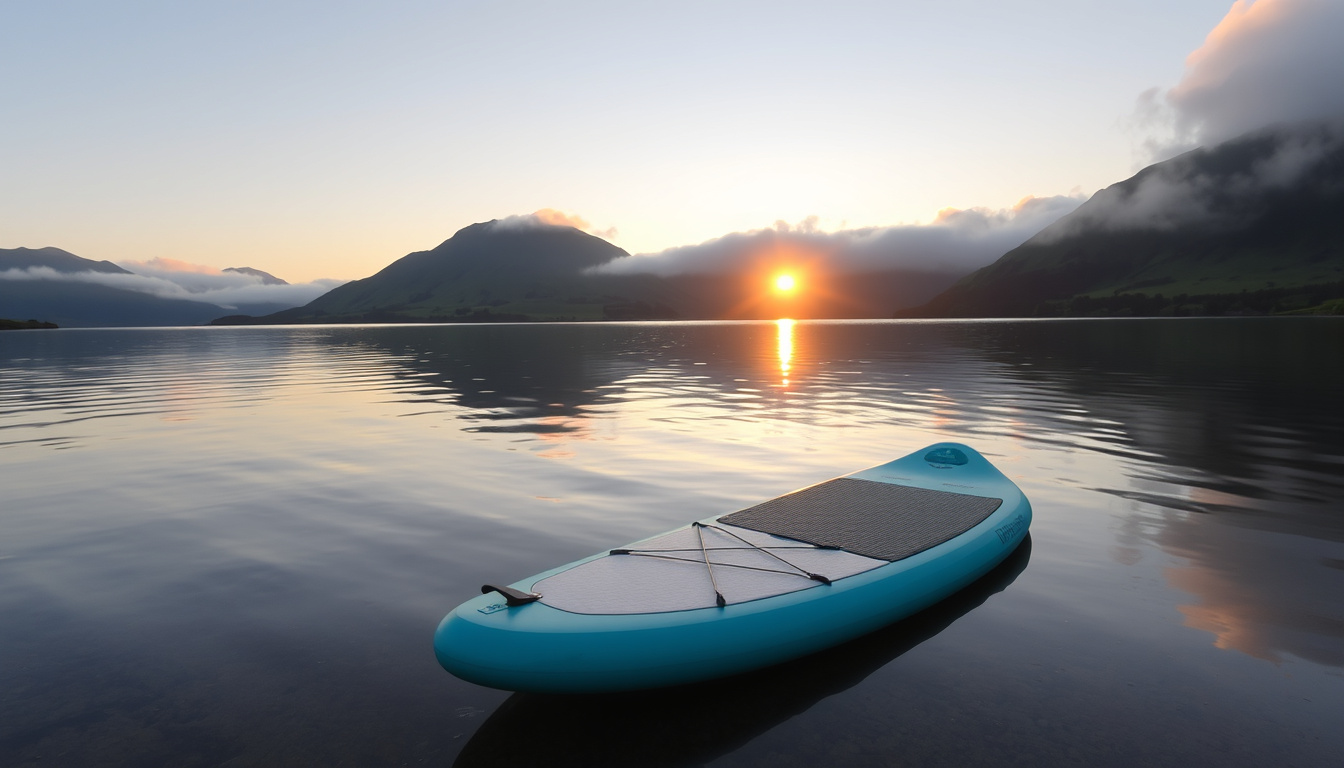
There is a moment on any quiet Irish harbour when someone stands up on a wobbly board for the first time, and the whole bay seems to hold its breath. Standing up on a paddle board looks like a party trick, but it is also one of the most accessible ways to get on the water — and in Ireland it costs less than a dinner out.
Board length range: 10–14 ft · Beginner width: 32 in or wider · Calories per hour: 305–430 · Dublin rental: €15–€25/hour
Quick snapshot
- SUP is simply stand-up paddleboarding; the terms are interchangeable. Encyclopaedia Britannica
- Wider boards (32 in+) and flat water are the two beginner shortcuts. Decathlon
- 305–430 calories per hour, comparable to a brisk walk. ACE Fitness
- Calm water first, shoe optional, board width second. Irish Government
| Attribute | Typical beginner value |
|---|---|
| Board width | 32–34 inches (81–86 cm) |
| Board volume | 220–320 L |
| Price range at Decathlon IE | €449 – €799 |
Is there a difference between a SUP and a paddle board?
The abbreviation SUP comes from stand-up paddleboarding, and the paddle board is just a shorter way of saying the same. There is no gear difference. SUP = paddleboard, paddleboard = SUP; in Ireland both are used for the same inflatable and hard boards. Encyclopaedia Britannica
Is SUP harder than a kayak?
Kayak engages the upper body in a seated position; SUP challenges balance and core. One isn’t generally better than the other, just a different muscle conversation — but if the choice is “harder”, SUP is seen as harder for balance, kayak for upper-body power. Canoe Ireland writes that new paddlers generally show up in a kayak and take to SUP only afterwards.
| Factor | Kayak | SUP |
|---|---|---|
| Balance | Low | High |
| Upper-body focus | High | Moderate |
| Burning calories / hour | 260–350 | 305–430 |
| Typical beginner | 15–30 min | first session to stand |
The pattern: SUP demands more from your core stability, while kayak relies on seated upper-body power.
How hard is paddle boarding as a beginner?
Practically anyone can paddle a board on flat water within the first session. The unstable part is the first few minutes while you learn the stance and the low back gets used to being a stabiliser. Wider boards (32 in+) make the first hour dramatically easier — the best beginner investment is width, not carbon. Irish Times fitness studies put the beginner learning curve between 2 and 6 sessions for the first stable paddle.
Does paddleboarding lose belly fat?
Paddleboarding works the core, arms, shoulders and back. Calories lost are similar to a brisk walk, but it is not a targeted spot-reducing exercise. The only way to “lose belly fat” is through a calorie deficit that uses the whole body. On SUP, this can mean 305-430 calories per hour while having fun. ACE Fitness categorises the energy draw as cardio-type, not a local fat-reduction.
Do you wear shoes on a SUP?
Bare feet on an inflatable deck is the usual choice, and a bootie or wet-shoe on rough or stony shorelines. Ireland’s own climate: a 5mm neoprene bootie — many records and let go. Department of Transport notes that slippery weed-covered slipways are the most hazardous to bare feet — hence it says “water boot” over “barefoot”.
The catch: barefoot on an inflatable deck is fine, but slipways and rocky shores call for 5mm neoprene booties to avoid injury.
Where can I buy a stand-up paddleboard in Ireland?
- Decathlon Decathlon — own-brand boards
- Lidl Lidl — seasonal SUP advertising
- Board supply and lesson SUP Ireland
Most boards sit well in the €800-€1000 band from Decathlon. Decathlon’s own ITIWIT boards are the easy ticket: €449–€549 depending on shape. Lidl and Aldi both release a board at the start of each summer in their seasonal “sports week”; they aren’t epic, but they do get people to the water who otherwise wouldn’t.
Ireland itself is an option. In Ireland you’ll find SUP.ie based in Bray (for midrange: €400–€700).
If you are a beginner, the 32-inch-wide ITIWIT 500 from Decathlon is the safest bet: it balances stability and portability at €549.
Where can I put my paddle board in Dublin?
Dublin’s smooth-water harbour spots are some of the best in Ireland. Dun Laoghaire County Council manages the harbour. Grand Canal Dock is flat, no waves and central: on the route of the LUAS and a 10 minute walk from the city. Waterways Ireland manages it. Malahide Estuary offers the most scenic water and the two islands that follow you to the sea.
The implication: Grand Canal Dock is the most beginner-friendly spot in the city because it offers flat water with easy access, but Malahide Estuary rewards you with views once you have basic balance.
Beginner how-to: first day, first hour
The classic first-day mistake is to aim too far back. Practice for the first time in the living room or basement. This article about “the four-toes-towards-3-point stand-up” shows the correction.
Take a lesson first. Even on still-water harbour, start with a wide heavy board and shallow water. Within the first 10 minutes you will be paddling and looking ahead, not down at the board.
Start with a stable, wide board
32 inches wide, 300 litres inflatable by Decathlon. The width covers you for stability while the springy material protects beginners.
Use one knee on the board
Begin on your knees, i.e. lower center of gravity, on calm water.
Paddle from the centre, not the side
Paddle from the centre, the shaft vertical. Paddle is perpendicular to the stringer, not angled like a kayak.
Look ahead, not at the board
The classic beginner loop: look down at the board, get wobbly. Keep your eyes on the horizon.
For a beginner in Ireland, starting with a 32-inch-wide inflatable board on flat water like Grand Canal Dock will get you standing within your first session.
Quotes & the line
Confirmed facts
- The terms are interchangeable — no gear difference
- Wide beginner boards (32 in +)
- Flat, sheltered water is the learning friend
What is not known
- Which Lidl boards will be available for 2024/2025
- Whether cheap shop own-brand boards last long
- Precise upgrade cost estimates by intensity
On price and width, the stable board is the factor that will shorten your learning to a single day — because in Ireland the weather is the largest decider.
assets.gov.ie, garda.ie, canoe.ie, gov.ie, adventuremarine.ie, gov.ie, reddit.com, goldenpages.ie, canoecentre.ie, echo.ie, irishstatutebook.ie, waterfordcouncil.ie
Frequently asked questions
Do you subtly mention how the ‘paddle board’ came about?
Is SUP good for weight loss?
Do I need a wetsuit in Ireland?
Is paddleboarding safe for everyone?
Is it possible to paddle an inflatable SUP on a rainy day?
Do I need a “special” board?
Related reading