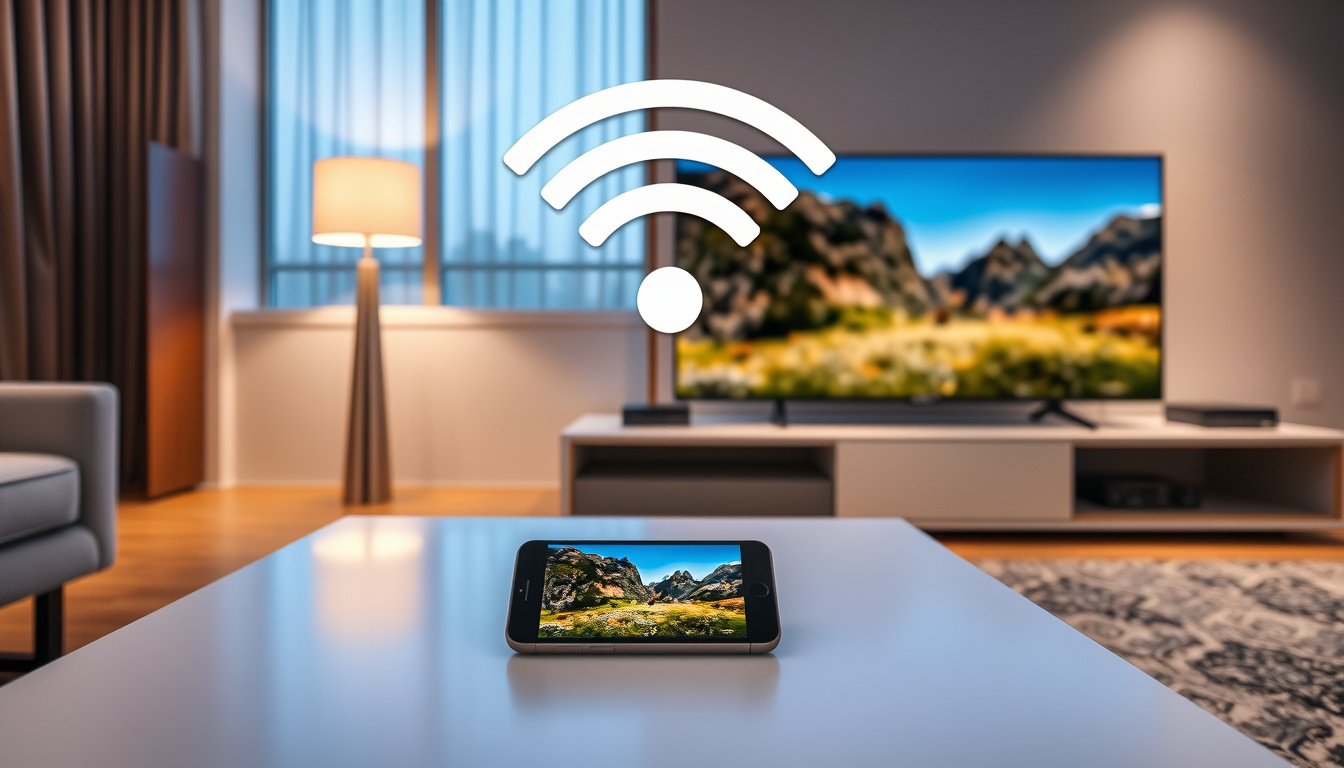
You’ve picked the perfect show on your phone, but the tiny screen just won’t cut it for movie night. With over 82% of U.S. households now owning a smart TV, the promise of wireless casting is more appealing than ever — yet many still hit a wall when trying to connect.
U.S. households with a smart TV (2023): 82% · Apple AirPlay compatible devices: Over 1.5 billion · Google Cast-enabled TV brands: Over 40
Quick snapshot
- Requires Chromecast device or built-in Chromecast (Google Support Community (official troubleshooting forum))
- Works with Android and iOS via Google Home app (Google Cast Help (device compatibility guide))
- Best for streaming video apps (Google Support Community (official troubleshooting forum))
- Compatible with Apple TV and AirPlay 2-enabled TVs (PigeonCast (streaming tech explainer))
- Screen mirroring accessed via Control Centre (Ravi Electronics (troubleshooting guide))
- No additional hardware needed for recent smart TVs (PigeonCast (streaming tech explainer))
- Requires USB-C to HDMI cable or MHL adapter (Cast Browser (wireless vs wired overview))
- No network needed — bypasses Wi‑Fi issues (Cast Browser (AP isolation fix))
- Ideal for gaming or presentations (low latency) (Cast Browser (wireless vs wired overview))
- Samsung Smart View, LG Screen Share, etc. (YouTube (Samsung TV guidance video))
- Usually works with same-brand phones (YouTube (Samsung TV guidance video))
- May require app installation (Sony Support (clearing app data fix))
| Year Chromecast launched | 2013 (Google Cast Help) |
| Number of AirPlay compatible devices | 1.5 billion+ (PigeonCast) |
| Android screen mirroring requirement | Miracast or Wi‑Fi Direct (Google Support Community) |
| Wi‑Fi requirement for casting | Both devices on the same network (Google Support Community) |
| Common fix – restart TV | Power‑reset or unplug briefly (Sony Support) |
| VPN may block casting | Disable VPN to allow local discovery (Cast Browser) |
| iPhone mirroring access | Control Centre → Screen Mirroring (Ravi Electronics) |
| Update Google Cast Receiver | From Google Play on TV (Google Streaming Help) |
How do I cast my phone screen to my TV?
Three main protocols connect your phone to the TV wirelessly. Which one you use depends on your phone type and TV capabilities.
Using Chromecast (Google Cast)
- Open the app you want to cast (YouTube, Netflix, etc.) and tap the Cast icon ().
- Select your TV from the list. A code may appear on screen – enter it to pair (Sony Support (pairing instructions)).
- Note: phone and TV must be on the same Wi‑Fi network (Google Support Community).
Using AirPlay (iPhone/iPad)
- Swipe down to open Control Centre, then tap Screen Mirroring.
- Choose your Apple TV or AirPlay 2-compatible smart TV (PigeonCast (AirPlay compatibility)).
- No additional hardware needed if your TV supports AirPlay 2.
Using Miracast (Android screen mirroring)
- Go to Quick Settings and tap Smart View (Samsung) or Screen Cast (other brands).
- The TV must support Miracast or Wi‑Fi Direct (Whizz Mobile (Android mirroring guide)).
- Some manufacturers hide the toggle – check Connected devices in Settings.
Most streaming apps use Google Cast or AirPlay, not screen mirroring, so casting is usually simpler and more stable. For unsupported apps, mirroring is your fallback – but expect higher battery drain and occasional lag.
How do I turn on casting on my phone?
The casting toggle location varies by phone maker, but the principle is the same: you’re telling your phone to look for nearby TVs.
On Android: Quick Settings > Smart View / Screen Cast
- Pull down the notification shade twice, look for the “Screen Cast” or “Smart View” icon (Whizz Mobile (Android toggle guide)).
- If you don’t see it, tap the pencil/edit icon in Quick Settings and drag the Cast tile into the active area.
- Some Samsung phones place “Smart View” in a separate panel – swipe left in Quick Settings to find it.
On iPhone: Control Center > Screen Mirroring (requires compatible receiver)
- Open Control Center (swipe down from upper-right or up from bottom on older iPhones).
- Tap “Screen Mirroring” – if no devices appear, make sure an Apple TV or AirPlay 2 TV is on and on the same network (Ravi Electronics (iPhone mirroring)).
- No toggle shows if no compatible receiver is discovered – that’s normal.
iPhone screen mirroring is locked to Apple’s ecosystem: you need an Apple TV or an AirPlay‑2‑licensed TV. Android users have wider flexibility but the toggle placement is unpredictable across brands like Samsung, Google Pixel, and Xiaomi.
How can I mirror my phone to my TV wirelessly?
Wireless mirroring (not app‑based casting) duplicates your phone’s entire display. Here are the three main tools.
Using Chromecast or Chromecast built‑in
- In the Google Home app, tap Devices, then Cast my screen (Google Streaming Help (screen mirroring)).
- Useful for showing photos, presentations, or non‑video apps.
- Latency is around 200–300 ms – fine for slides, not ideal for fast games.
Using Roku or Amazon Fire Stick
- Roku: Enable screen mirroring in Settings → System → Screen mirroring.
- Fire Stick: Use the Fire TV app (Android) or AirPlay (iPhone) – no direct Android mirroring.
- Both require the stick and phone to be on the same network.
Using third‑party apps (e.g., Mirror for Samsung TV)
- Apps like “Mirror for Samsung TV” or “AllCast” can bridge gaps, but many are ad‑supported or require paid upgrades.
- Quality varies: some compress video heavily (PigeonCast (app limitations)).
How do I cast my phone on a smart TV?
Each TV brand has its own cast feature. Knowing the exact name saves you time.
Samsung: Smart View or Tap View
- Pull down Quick Settings on any Samsung phone and tap Smart View (YouTube (Samsung TV guidance)).
- Tap View works with Samsung phones on Samsung TVs (2020+) – tap phone to TV.
- Note: Smart View often uses a Miracast variant, so compatibility is best with Samsung phones.
LG: Screen Share (Miracast) or AirPlay (2019+ models)
- Press the Settings button on the remote, then select Screen Share.
- On Android, use LG TV Plus app for quick pairing (Whizz Mobile (LG pairing)).
- LG TVs from 2019 support AirPlay 2 for iPhone mirroring.
Sony: Screen mirroring (Android) or AirPlay
- Open the “Screen mirroring” app on your Sony TV, then mirror from Android’s Quick Settings.
- For iPhone, ensure AirPlay is enabled on the TV (Sony Support (airplay settings)).
- If mirroring fails, clear data for the Cast function apps in Settings (as recommended by Sony).
Cross‑brand compatibility is hit or miss. A Samsung phone pairs seamlessly with a Samsung TV using Smart View, but might not even detect a Sony TV for screen mirroring. When in doubt, use a streaming stick – it acts as a neutral middleman.
Why is my phone not letting me cast to TV?
Casting failures are maddening but usually fixable. Here’s the systematic troubleshooting checklist.
Check Wi‑Fi network (both devices on same band)
- Confirm phone and TV are connected to the same network — guest networks or separate 2.4/5 GHz SSIDs can block discovery (Ravi Electronics (band matching)).
- Try connecting both to the 2.4 GHz band if 5 GHz gives intermittent issues.
Update phone and TV firmware
- Outdated software is a top cause. Update Android/iOS and check for TV system updates (Google Support Community (software update advice)).
- On Android TV, update the Google Cast Receiver from the Play Store.
Restart both devices and router
- Power‑cycle the TV (unplug for 30 seconds) and restart your phone (Sony Support (power reset fix)).
- Reboot the router if possible – this clears temporary network glitches.
A single misconfigured router setting (AP isolation, band steering, VPN) can turn a simple cast into a 30‑minute headache. The fix is almost always on the network side, not the phone. Before buying new hardware, double‑check your router’s isolation settings and disable any VPN temporarily.
Confirmed facts
- AirPlay requires Apple TV or AirPlay 2-compatible TV (PigeonCast)
- Google Cast works with Android and iOS (Google Cast Help)
- Miracast is built into many Android phones (Whizz Mobile)
- Restarting TV resolves many casting issues (Sony Support)
What’s unclear
- Whether all Android phones support Miracast (varies by manufacturer) (Whizz Mobile)
- Whether casting over Bluetooth is possible for video (Bluetooth limited to audio) (PigeonCast)
On your Android phone, open the Google TV app. Tap TVs nearby. Enter the code that displays on your TV screen. Tap Pair. Tap Watch on TV.
Google Streaming Help (official pairing instructions)
Restarting or power resetting the TV when Google Cast fails can resolve many connectivity issues.
Sony Support (common troubleshooting step)
For anyone struggling with wireless casting, the fix is often simpler than it seems: check your network, update your software, and match the protocol to your TV. The trade-off for older TVs without built‑in support? An inexpensive streaming stick eliminates most compatibility headaches. For related screen‑based how‑tos, see our guide on How to Screenshot on PC: 5 Easy Methods for Windows 10 & 11 and Are Fortnite Servers Down? Server Status & Troubleshooting.
imobie.com, support.google.com, thetoolstrunk.com, wikihow.com
Frequently asked questions
Do I need Wi‑Fi to cast from my phone to my TV?
Not always. Wired HDMI connections work without Wi‑Fi. Wireless casting typically requires the phone and TV to be on the same local network (Google Support Community). Some devices support Wi‑Fi Direct, which creates a point‑to‑point link without a router.
Can I cast to a non‑smart TV?
Yes, using a streaming device like Chromecast, Roku, or Amazon Fire Stick. Plug the device into an HDMI port, connect it to Wi‑Fi, and cast from your phone (Google Streaming Help).
What is the best app for screen mirroring?
For Android, the built‑in Screen Cast/Smart View is usually best. For iPhone, AirPlay is the most reliable. Third‑party apps like Mirror for Samsung TV or AllCast can help but may introduce ads or compression (PigeonCast).
Does casting drain phone battery quickly?
Yes—especially screen mirroring, which keeps the display on and the processor active. App‑based casting (e.g., sending a YouTube video to the TV) uses less power because the phone acts as a remote. Expect 15–25% battery drain per hour of mirroring.
Can I use my phone while casting?
If you’re using app‑based casting (Chromecast/AirPlay from a streaming app), yes—the video plays on the TV independently. If you’re screen mirroring, whatever you do on the phone appears on the TV.
Is casting the same as screen mirroring?
No. Casting sends a media stream (video/audio) from an app to the TV while the phone remains free. Screen mirroring duplicates your phone’s entire display on the TV (Google Cast Help).
How do I stop casting from my phone?
Tap the Cast icon again and select “Stop casting” or “Disconnect.” On iPhone, tap the Screen Mirroring icon and choose “Stop Mirroring.”