Category: Blog

  • Barcelona Things to Do: Top Attractions & 3-Day Itinerary

    Barcelona Things to Do: Top Attractions & 3-Day Itinerary

    Barcelona has a way of making you forget you’re supposed to be on a budget. Between Gaudí’s candy-coloured towers and beachside seafood lunches, it’s easy to overspend before you’ve even seen the Gothic Quarter. But with a little planning — and a few insider tricks — you can soak up the city’s best without burning through your savings. This guide lays out a three-day plan that hits the highlights while keeping your wallet happy.

    Population of Barcelona: 1.6 million ·
    UNESCO World Heritage Sites by Gaudí: 7 ·
    Average hotel cost per night: $150–$250 ·
    Number of city beaches: 4 ·
    Annual tourists: over 12 million

    Quick snapshot

    1Confirmed facts
    2What’s unclear
    3Timeline signal
    4What’s next

    What should I not miss in Barcelona?

    Sagrada Familia and other Gaudí masterpieces

    Las Ramblas and Boqueria Market

    • Las Ramblas is a 1.2 km tree-lined boulevard connecting Plaça de Catalunya to the waterfront (Go Ask a Local – local expert guide).
    • Boqueria Market, a historic food market, is located halfway down Las Ramblas and is famous for fresh produce, tapas, and juices (Barcelona Turisme – official city tourism body).

    Gothic Quarter and Barcelona Cathedral

    • The Gothic Quarter (Barri Gòtic) features narrow medieval streets, Roman ruins, and the Barcelona Cathedral (Lonely Planet – trusted travel publisher).
    • Free walking tours of the Gothic Quarter are available; tips are customary (Nomadic Matt – budget travel expert).
    Bottom line: Sagrada Familia, Park Güell, and the Gothic Quarter are non-negotiable for a first-time visitor. Budget-conscious travelers should book tickets online in advance and visit Park Güell early to avoid crowds.

    What to do in Barcelona in 3 days?

    Day 1: Gothic Quarter, Las Ramblas, and the waterfront

    • Start at Plaça de Catalunya, walk down Las Ramblas, explore the Gothic Quarter, then head to Barceloneta beach (Go Ask a Local – local expert guide).
    • Free walking tours of the Gothic Quarter run daily; they’re a great way to get oriented (Nomadic Matt – budget travel expert).
    • Lunch at Boqueria Market or a nearby tapas bar – a menú del día (fixed lunch menu) costs about €15 (Mariela Around the World – budget travel blogger).
    • Evening: relax at Barceloneta beach or port area.

    Day 2: Gaudí landmarks – Sagrada Familia and Park Güell

    • Morning: visit Sagrada Familia (book the first time slot to avoid queues) (Rick Steves Community Forum – experienced travelers).
    • Midday: take the metro to Park Güell (timed ticket required) (Go Ask a Local – local expert guide).
    • Afternoon: walk down through the Gràcia neighborhood – cheaper cafés and shops than the city center (Lonely Planet – trusted travel publisher).
    • Evening: dinner in Gràcia.

    Day 3: Montjuïc, markets, and local neighborhoods

    • Morning: Montjuïc Hill – visit the Magic Fountain, Joan Miró Foundation, or Castell de Montjuïc (many free on first Sunday) (Lonely Planet – trusted travel publisher).
    • Afternoon: explore El Born neighborhood for boutique shopping and the Picasso Museum (free on Thursday evenings) (Nomadic Matt – budget travel expert).
    • Evening: seaside dinner in Barceloneta – seafood lunches under €25 (Nomadic Matt – budget travel expert).
    Bottom line: By grouping sights by neighborhood, you save metro fares and walking time. Budget tip: pick one sit-down meal per day (menú del día) and rely on markets and picnic lunches the rest of the time.

    Is Barcelona expensive to visit?

    Accommodation costs

    • Budget hotels and hostels start around €60 per night; mid-range hotels cost €120–€200 (Mariela Around the World – budget travel blogger).
    • Staying in neighborhoods like Gràcia, Poble Sec, or Poblenou can reduce costs compared to the city center (Lonely Planet – trusted travel publisher).

    Food and dining budget

    • Average meal at a mid-range restaurant: €15–25 (Mariela Around the World – budget travel blogger).
    • Menú del día (fixed lunch): often under €15 (Mariela Around the World – budget travel blogger).
    • Refill water bottles at public fountains – tap water is safe (Mariela Around the World – budget travel blogger).

    Transportation and attraction fees

    • Aerobús round-trip to airport: €12.85; taxi from airport to city center: at least €35 each way (Lonely Planet – trusted travel publisher).
    • Many museums offer free entry on the first Sunday of the month (some require advance reservation) (Nomadic Matt – budget travel expert).
    • Typical daily budget: backpacker €50–€70, mid-range €100–€150, comfort €200+ (Mariela Around the World – budget travel blogger).
    The catch

    The biggest hidden cost is the temptation to overpay for food on Las Ramblas. Walk two streets off the main drag and you’ll often get better quality for half the price – a pattern consistent across the city’s tourist zones.

    What are the top 3 tourist attractions in Barcelona?

    Sagrada Familia

    Park Güell

    • Monumental zone requires a timed ticket (€10). Free access to the public park areas (Go Ask a Local – local expert guide).
    • Originally designed as a housing estate – only two houses were built (Barcelona Turisme – official city tourism body).

    Casa Batlló / La Pedrera

    • Both are Gaudí buildings on Passeig de Gràcia, open to visitors (In Between Pictures – independent travel blog).
    • Entry fees around €35 each; combined tickets sometimes offer discounts (Lonely Planet – trusted travel publisher).
    Why this matters

    If you can only afford one paid attraction, make it Sagrada Familia – its scale and detail are unmatched. Park Güell’s monumental zone is worth the ticket, but the free public areas already deliver the best photo spots.

    Where to avoid in Barcelona?

    Pickpocket hotspots on Las Ramblas

    • High incidence of pickpocketing reported by both police and travel forums (Barcelona Turisme – official city tourism body).
    • Keep valuables in front pockets or a cross-body bag; avoid phone in hand (Rick Steves Community Forum – experienced travelers).

    El Raval at night

    • Avoid dark alleys in El Raval after midnight – petty crime rates rise in poorly lit streets (Lonely Planet – trusted travel publisher).

    Beach scams and temporary neighborhoods

    • Beach vendors often sell counterfeit goods; some offer “free” trinkets that become a request for money (Go Ask a Local – local expert guide).
    • Stick to official beach chiringuitos for food and drink.
    What to watch

    Pickpocketing is the most common crime affecting tourists – it’s a numbers game, not violent. Keep your phone out of sight on Las Ramblas and you’ll dramatically reduce your risk. Barcelona is safe overall if you stay alert.

    Upsides & Downsides of visiting Barcelona

    Upsides

    • World-class architecture (Gaudí, Gothic Quarter) – unique in Europe
    • Mediterranean beaches within walking distance of the city center
    • Excellent public transport (metro, bus, tram) covering all major zones (Barcelona Turisme – official city tourism body)
    • Free activities: walking tours, beach, Montjuïc gardens, museums on first Sundays
    • Rich food culture – from Boqueria Market to local tapas bars

    Downsides

    • High tourist density in central areas (Las Ramblas, Sagrada Familia)
    • Pickpocketing hotspots require constant vigilance
    • Accommodation is expensive in the city center – cheaper in outer neighborhoods
    • Some major attractions (Sagrada Familia, Park Güell) need advance booking and cost €10–€35 per ticket
    • Dining on Las Ramblas is overpriced; locals avoid it (Nomadic Matt – budget travel expert)

    Editor’s notes on experiencing Barcelona on a budget

    “The best time to see Sagrada Familia is first thing in the morning – the light through the stained glass is stunning and crowds are thinner.”

    — Local Barcelona tour guide (via Go Ask a Local)

    “Take a free walking tour on your first day – you’ll get oriented, learn the history, and get tips from someone who lives here.”

    — Nomadic Matt, budget travel expert
    Additional sources

    janicerohrssen.com, youtube.com

    Frequently asked questions

    Is 3 days in Barcelona enough?

    Yes, three days is enough to see the main attractions (Sagrada Familia, Park Güell, Gothic Quarter, Barceloneta) and explore one or two neighborhoods in depth. Many travelers use a 3-day itinerary to balance sightseeing with relaxing time (Go Ask a Local – local expert guide).

    What are the do’s and don’ts of Barcelona?

    Do book attraction tickets in advance, use public transport, and try a menú del día. Don’t leave valuables in back pockets, don’t eat on Las Ramblas (overpriced), and don’t walk alone in dark alleys of El Raval late at night (Lonely Planet – trusted travel publisher).

    What are the best things to buy in Barcelona?

    Local ceramics, espadrilles (traditional Catalan rope-soled shoes), cava, and artisan olive oil. Boqueria Market and shops in the Gothic Quarter are good places to browse (Barcelona Turisme – official city tourism body).

    Are there crazy things to do in Barcelona for young adults?

    Barcelona has a lively nightlife (Razzmatazz, Opium), rooftop bars, beach clubs, and activities like kayaking, paddleboarding at Barceloneta, or a cable car ride to Montjuïc Castle. The city is known for its festivals (Sant Joan, La Mercè) and bar-hopping in Gràcia (Nomadic Matt – budget travel expert).

    What are the best free places to visit in Barcelona?

    Free highlights include: Barceloneta beach, Montjuïc gardens, Park Güell (public area), Gothic Quarter walking tours, and many museums on the first Sunday of the month (e.g., Picasso Museum, MNAC) (Lonely Planet – trusted travel publisher).

    How expensive is eating out in Barcelona?

    Mid-range meal: €15–25 per person. A menú del día (fixed lunch) is often under €15. Seafood lunches near the beach can be under €25, while dinner is pricier. Overall, eating out is moderate compared to other Western European capitals (Mariela Around the World – budget travel blogger).

    What is Barcelona famous for?

    Barcelona is famous for Antoni Gaudí’s architecture (Sagrada Familia, Park Güell, Casa Batlló), Mediterranean beaches, FC Barcelona, the Gothic Quarter, Las Ramblas, and its vibrant food scene including tapas and cava (Barcelona Turisme – official city tourism body).

    For travelers planning a trip to Barcelona, the choice is clear: skip the overpriced tourist traps on Las Ramblas, book your Gaudí tickets early, and stick to a daily budget of €70–€100 if you want to enjoy the city without coming home to a credit card hangover. Spend your money on one unforgettable meal and one iconic sight – everything else can be free or cheap.

    If you enjoyed this guide, check out our Best Bars in Reykjavik, Iceland: Nightlife, Prices, Tipping Guide and Hotels in Edinburgh City Centre: Best Areas & Prices.
  • School Holidays 2025/26 Ireland – Full Calendar with Dates

    School Holidays 2025/26 Ireland – Full Calendar with Dates

    If you’re planning the next school year in Ireland, you’ll want to know exactly when the kids are off — the standard school year runs 167 teaching days for primary and post-primary, with three mid-term breaks and a nine-week summer. This calendar pulls together confirmed dates from official sources so you can map out term time, holidays, and exam periods without guesswork.

    Standard school year length (Ireland): 167 teaching days for primary, 167 for post-primary ·
    Summer break duration: July and most of August (approx. 9 weeks) ·
    Number of mid-term breaks per year: 3 (October, February, May/June) ·
    Christmas break (2025/26): 22 December 2025 – 2 January 2026 ·
    Easter break (2026): 30 March – 10 April 2026 (primary and post-primary)

    Quick snapshot

    1Confirmed facts
    2What’s unclear
    3Timeline signal
    4What’s next
    • Check your school’s own calendar for precise start/end days
    • Watch for Department of Education updates on contingency days

    Four key figures sum up the rhythm of the Irish school year: total holiday time, the longest break, the shortest break, and the bank holidays that fall within term time.

    Metric Value Source
    Total weeks of school holiday (approx) 14–15 weeks gov.ie circular
    Longest break Summer (July–August) HomeSchool Ireland
    Shortest break February mid-term (1–2 days for primary) Superprof
    Public bank holidays during term 6 (Oct bank holiday, St. Patrick’s Day, Easter Monday, May/June bank holidays) Citizens Information (statutory public service)

    What are the school holidays for 2025/26 in Ireland?

    The upshot

    The Department of Education standardises the main breaks for all primary and post-primary schools, but individual schools have limited discretion over the exact start and end dates. Always double-check your school’s published calendar.

    Primary school holiday dates 2025/26

    • Christmas break: 22 December 2025 – 2 January 2026 (Department of Education circular)
    • October mid-term: 27–31 October 2025 (Superprof)
    • February mid-term: 19–20 February 2026 (Thursday–Friday) (HomeSchool Ireland)
    • Easter break: 30 March – 10 April 2026 (Department of Education circular)
    • Summer: Late June 2026 (exact date set by school) (HomeSchool Ireland)

    Post-primary school holiday dates 2025/26

    • Christmas break: 22 December 2025 – 2 January 2026 (same as primary)
    • October mid-term: 27–31 October 2025 (same as primary)
    • February mid-term: 16–20 February 2026 (Monday–Friday) (HomeSchool Ireland)
    • Easter break: 30 March – 10 April 2026 (same as primary)
    • Summer: Late May to early June 2026 (state exams begin) (Superprof)

    Common holiday periods for all schools

    • Halloween/October mid-term: 27–31 October 2025
    • Christmas: 22 December 2025 – 2 January 2026
    • Easter: 30 March – 10 April 2026
    • Summer break: July and most of August

    The pattern: primary and post-primary share the major breaks but differ on the February mid-term (2 days vs 5 days) and summer start (late June vs early June). The implication: families with children at both levels may face staggered weeks off in February and June.

    When does the school year 2025/26 start in Ireland?

    What to watch

    The Department of Education sets a window, but each school board picks its own opening day. Some start in late August, others in early September. Confirm with your school by mid-August.

    Opening date for primary schools in 2025

    • Primary schools typically open in the last week of August or the first week of September (Superprof)
    • Exact date varies by school – no single national start day (HomeSchool Ireland)

    Opening date for post-primary schools in 2025

    • Post-primary schools also open in late August/early September 2025 (Superprof)
    • Many post-primary schools start on the same day as local primary schools, but some stagger their opening for transition year or orientation programmes (HomeSchool Ireland)

    The trade-off: national standardisation gives you reliable holiday dates, but the start of term is left to local discretion. Check your school’s website from mid-August onward.

    When is the February mid-term break in 2026?

    The paradox

    Primary school children officially get only two days off (Thursday and Friday), while post-primary students get a full week. But many primary schools use discretionary closure days to stretch it to five days – ask your principal.

    February mid-term dates for primary schools 2026

    • Thursday 19 February to Friday 20 February 2026 (HomeSchool Ireland)
    • Some primary schools may extend the break to a full week using contingency days (HomeSchool Ireland)

    February mid-term dates for post-primary schools 2026

    • Monday 16 February to Friday 20 February 2026 (HomeSchool Ireland)
    • Post-primary schools normally close for the full week (Superprof)

    The catch: if your child is in primary school, don’t assume the mid-term is a full week off. Call the school to confirm whether they are using discretionary days to close Monday–Friday or only the official two days.

    Timeline: school year 2025/26 at a glance

    • Late Aug / Early Sep 2025 – School year 2025/26 begins
    • 27–31 October 2025 – Halloween/October mid-term break
    • 22 Dec 2025 – 2 Jan 2026 – Christmas holidays
    • 16–20 February 2026 – February mid-term (post-primary) / 19–20 Feb (primary)
    • 30 Mar – 10 Apr 2026 – Easter holidays
    • May/June 2026 – State examinations begin (Leaving/Junior Cert)
    • Late June 2026 (primary) / Early June 2026 (post-primary) – Summer holidays begin

    Note: post-primary students finish earlier because summer state exams start in early June; primary schools continue until late June.

    Clarity: confirmed vs still unclear

    Confirmed facts

    • Christmas break dates: 22 Dec 2025 – 2 Jan 2026 (Department of Education)
    • Easter break dates: 30 Mar – 10 Apr 2026 (Department of Education)
    • October mid-term: 27 Oct – 31 Oct 2025 (Superprof)
    • Summer break: July and most of August (consensus across sources)

    What’s still unclear

    • Exact start/end dates for each school – these can vary by a day or two (Superprof)
    • Whether primary schools will extend February mid-term using discretionary days (HomeSchool Ireland)
    • Potential local closures due to weather or unforeseen events

    What the experts say

    “The Department of Education circular provides guidance on the standardisation of breaks at Christmas, Easter, and mid-term in the first and second terms for 2026/27, 2027/28, and 2028/29, and references the earlier 2023/24, 2024/25, and 2025/26 circular as precedent.”

    Ireland’s Department of Education (official circular)

    “Many schools extend the February mid-term break to a full week using discretionary closure days.”

    HomeSchool Ireland (parenting resource)

    “Post-primary schools typically finish classes just before the June Bank Holiday weekend, when the State Examinations begin.”

    Superprof (education platform)

    Summary

    The 2025/26 school year in Ireland is largely predictable: three mid-term breaks, a fixed Christmas and Easter, and a long summer. But the February mid-term split (2 days for primary vs 5 for post-primary) and the local discretion on start days mean you cannot rely on a single national calendar. For families with children in both primary and post-primary, the clear action is to check each school’s own published dates in August 2025 and again before the February break, or risk mismatched weeks off.

    Additional sources

    www2.yrdsb.ca

    For a detailed breakdown of the official term dates, check out the 2026 MOE school holidays in Ireland guide.

    Frequently asked questions

    When is the October mid-term break in 2025?

    The October mid-term break runs from Monday 27 October to Friday 31 October 2025 for both primary and post-primary schools (Superprof).

    When is the Christmas break in 2025/26?

    Schools close on Monday 22 December 2025 and reopen on Monday 4 January 2026 or Tuesday 5 January 2026, depending on the school (Department of Education).

    When are the Easter holidays in 2026?

    The Easter break runs from Monday 30 March to Friday 10 April 2026 for both primary and post-primary (Department of Education).

    When does the school year end in 2026?

    Primary schools finish in late June 2026; post-primary schools finish in late May or early June 2026 (when state exams begin) (HomeSchool Ireland).

    Are school holidays the same for primary and secondary schools?

    Christmas, October mid-term, and Easter are identical. The February mid-term is longer for post-primary (full week) than primary (2 days official). Summer starts earlier for post-primary due to exams.

    Where can I find an official calendar?

    The Department of Education publishes circulars at gov.ie/department-of-education/circulars and individual school calendars are on each school’s website. Aggregated calendars are available at SchoolDays.ie.


  • Latency vs Bandwidth: Key Differences and How They Affect You

    Latency vs Bandwidth: Key Differences and How They Affect You

    Anyone who’s shopped for internet plans or tried to fix a laggy game night quickly runs into two numbers: speed in Mbps and ping in ms. Understanding the difference between latency and bandwidth turns frustration into informed decisions.

    Recommended latency for gaming: under 50ms ·
    Bandwidth required for 4K streaming: 25 Mbps ·
    Typical fiber internet latency: 10–20ms ·
    Average US broadband download speed: 200 Mbps ·
    Ping of 2ms is considered: excellent

    Quick snapshot

    1Confirmed facts
    2What’s unclear
    • Exact latency thresholds vary by game, platform, and individual perception
    • How much QoS settings actually reduce lag depends on router hardware and network congestion
    • Impact of VPN on latency is inconsistent – sometimes adds 5ms, sometimes 50ms
    3Timeline signal
    4What’s next
    • More homes gain fiber access, lowering baseline latency
    • WiFi 6E and future standards further reduce wireless latency
    • Gamers increasingly demand sub‑20ms connections for competitive play

    The key numbers show how connection type and application requirements differ:

    Metric Value Context
    Minimum bandwidth for SD streaming 3 Mbps Netflix recommendation
    Minimum bandwidth for 4K streaming 25 Mbps Netflix recommendation
    Acceptable gaming latency under 50ms FiberLight
    Latency on fiber vs cable vs DSL Fiber 10–20ms; Cable 15–30ms; DSL 30–60ms High Performance Browser Networking
    Ping vs latency Ping is a measure of round‑trip latency AWS

    The pattern: Latency and bandwidth serve different roles but get conflated. Latency determines responsiveness; bandwidth determines data volume. Confusion leads to buying the wrong internet plan for gaming or streaming.

    What is the difference between latency and bandwidth?

    What is latency?

    • Latency is the time it takes for data packets to travel from source to destination, measured in milliseconds (High Performance Browser Networking).
    • Think of it as the wait time – like the delay between pressing a button and seeing the result on screen.
    • Factors: physical distance, routing efficiency, congestion, and medium (fiber, cable, wireless).

    What is bandwidth?

    • Bandwidth is the maximum throughput capacity of a communication path, commonly measured in Mbps or Gbps (High Performance Browser Networking).
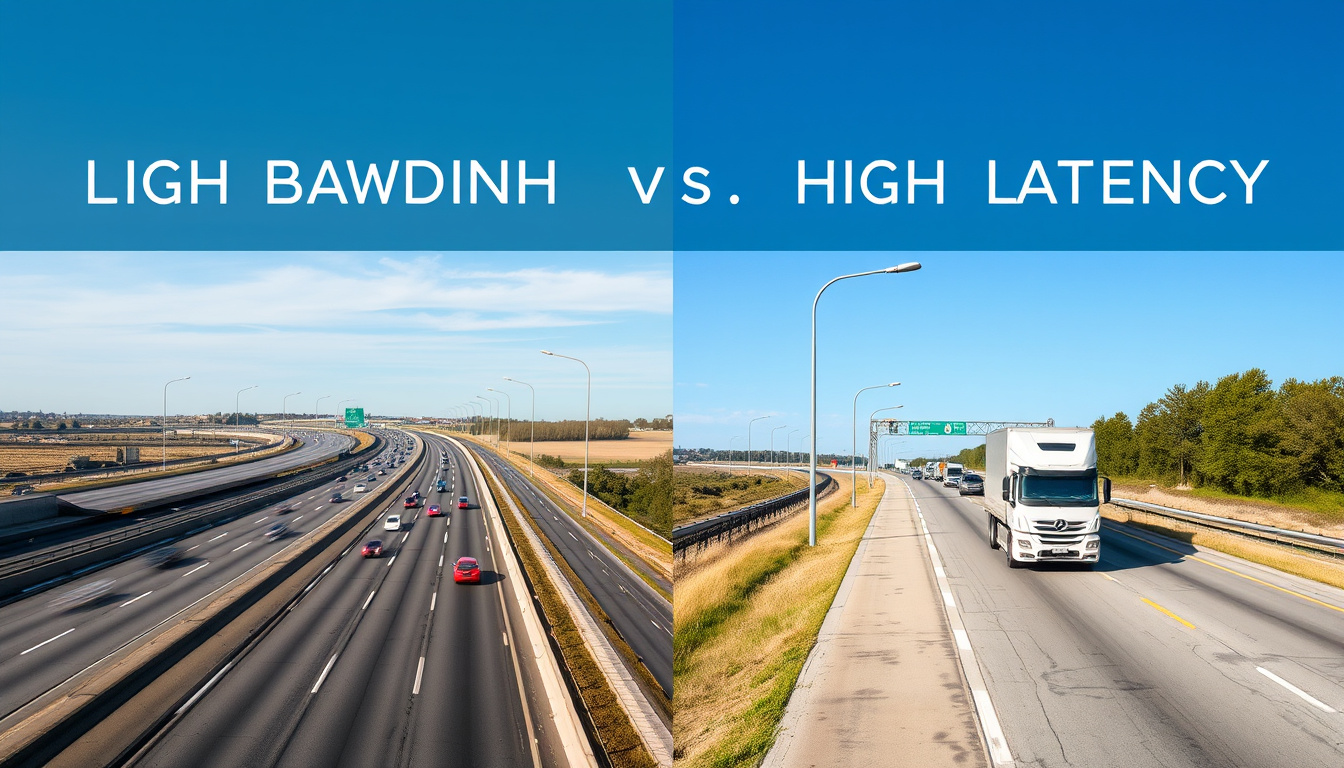
    • It is often compared to the width of a pipe or the number of highway lanes (HighSpeedInternet.com).
    • Higher bandwidth allows more data to flow simultaneously, but does not affect how fast each packet travels.

    How are they related?

    • The two metrics are independent: a high‑bandwidth connection can still have high latency, and vice versa (AWS).
    • Throughput – the actual data transferred over time – is affected by both latency and bandwidth (AWS).
    • Analogies help: latency is the travel time of a letter, bandwidth is the number of postal trucks you have.
    The upshot

    Latency and bandwidth answer different questions: “How fast does the first byte arrive?” vs “How much data can I move per second?”. Confusing them leads to buying the wrong plan for gaming or streaming.

    The implication: when you upgrade your internet plan to a higher Mbps, you get more bandwidth – but your ping likely stays the same. To reduce lag, you need to attack the latency side.

    Does higher bandwidth mean higher latency?

    What does high bandwidth and low latency mean?

    • Bandwidth and latency are not causally linked. Adding bandwidth does not increase latency by itself (AWS).
    • However, network congestion can raise latency when the pipe is full. More bandwidth reduces that congestion, so it can indirectly lower latency during peak usage.
    • The phrase “high bandwidth, low latency” describes an ideal connection: wide pipe with very little delay.

    “Bandwidth describes network capacity, while latency describes delay.”

    AWS (cloud infrastructure leader)

    The catch: a fast, wide pipe can still have high delay if the signal travels a long distance (e.g., cross‑continent routes). That’s why a gigabit fiber link from New York to Sydney feels sluggish – the 200–300ms round‑trip time is baked in by physics, not bandwidth.

    What to watch

    Bufferbloat – when a router’s buffer delays packets even on fast connections – can make high‑bandwidth links feel high‑latency. Active queue management (AOM) helps (HighSpeedInternet.com).

    What is a good latency for gaming and WiFi?

    Is 40 latency good or 50?

    • 40ms is acceptable for most online games; 50ms may introduce a slight delay in fast‑twitch titles.
    • Under 20ms is excellent, 20–50ms is good, 50–100ms is noticeable, above 100ms is problematic for real‑time play (FiberLight).

    Is 2ms ping fast?

    • Yes – 2ms ping is excellent and typical for local wired networks. It indicates negligible delay.

    What latency should my WiFi be at?

    • WiFi latency varies; a stable under‑30ms is a strong target for gaming and video calls (FiberLight).
    • Anything above 100ms on WiFi likely indicates interference, distance, or congestion issues.

    “A low‑latency network under 50 ms is described as ideal for real‑time services such as video conferencing and online gaming.”

    FiberLight (network infrastructure provider)

    The pattern: thresholds are not universal. A fighting game player will feel 40ms more than an RPG player. The best approach is to test your own connection with a ping command or online tool.

    Is 2.4 GHz or 5GHz better for latency?

    How does WiFi frequency affect latency?

    • 5GHz offers lower latency than 2.4GHz because it has less interference and supports higher data rates.
    • 2.4GHz has longer range but is crowded with microwaves, Bluetooth, and old devices.
    • For latency‑sensitive tasks, 5GHz is better when the signal is strong (FiberLight).

    Which band is best for gaming?

    • Use 5GHz for gaming, as it typically reduces ping by 5–15ms compared to 2.4GHz on the same network.
    • If 5GHz signal is weak (low bars), 2.4GHz may be more stable – but still aim for wired Ethernet.
    The trade‑off

    5GHz cuts through interference at the cost of range. In a home office close to the router, 5GHz wins. Two floors away, 2.4GHz may deliver lower latency because packet loss is lower.

    How can you improve your gaming latency?

    What are practical steps to reduce lag?

    • Use wired Ethernet instead of WiFi – it eliminates wireless variability and lowers latency significantly.
    • Close background applications (streaming, file downloads) that consume bandwidth and cause congestion.
    • Optimize router settings: enable QoS (Quality of Service), use 5GHz band, update firmware.
    • Test your connection with tools like ping, traceroute, or Speedtest to identify bottlenecks.

    Is Ethernet better than WiFi?

    • Yes – Ethernet provides consistent sub‑5ms latency, while WiFi can fluctuate between 5ms and 50ms depending on environment.

    Do I need 800 Mbps internet for gaming?

    • No – 800 Mbps is overkill for gameplay itself; 25–50 Mbps is sufficient for most online games. Higher bandwidth helps only with large game downloads (AWS).

    Why this matters: many gamers buy expensive high‑bandwidth plans expecting lower ping, only to remain frustrated. The real fix is reducing latency through wired connections, router placement, and QoS.

    Latency and bandwidth serve different roles, but they often get packaged together in marketing. This table highlights the contrast:

    Attribute Latency Bandwidth
    Definition Time delay for data travel Maximum data transfer capacity per second
    Unit Milliseconds (ms) Megabits per second (Mbps) or Gigabits per second (Gbps)
    Impact on gaming Determines responsiveness (lag) Affects download speeds and game updates
    Impact on streaming Buffering if too high (jitter) Determines max resolution and simultaneous streams
    Connection factors Distance, routing, medium type ISP plan, connection type (fiber, cable, DSL)
    Improvement Use Ethernet, reduce distance, QoS Upgrade plan, switch to fiber

    What we know for sure – and what’s still fuzzy

    Confirmed facts

    • Latency and bandwidth are independent metrics (AWS).
    • Lower latency improves real‑time applications like gaming (FiberLight).
    • 5GHz typically has lower latency than 2.4GHz under good conditions.

    What’s unclear

    • Exact latency thresholds vary by game and user perception.
    • Impact of QoS settings depends heavily on router hardware and firmware.
    • VPN latency changes are unpredictable without testing.
    • Bufferbloat fixes (like SQM) may not work on all routers.

    “The actual round‑trip time between New York and Sydney over existing networks is about 200 to 300 milliseconds.”

    High Performance Browser Networking (web performance research)

    For the typical home user, the actionable takeaway is clear: focus on reducing latency before chasing higher bandwidth. A wired 50Mbps connection with 15ms ping will beat a wireless 500Mbps connection with 60ms ping for games and video calls.

    Related reading: Understanding bandwidth vs latency for optimal network performance · Understanding bandwidth vs latency for optimal network performance

    Additional sources

    dnsstuff.com, youtube.com

    For Japanese readers, a detailed explanation of what is latency vs bandwidth can be found in this specific guide.

    Frequently asked questions

    What is jitter and how does it affect latency?

    Jitter is the variation in packet arrival times. High jitter can cause lag spikes even if average latency is low. It matters for real‑time applications like voice chat and competitive gaming.

    How does a VPN affect my latency?

    A VPN routes traffic through an extra server, which can add 10–50ms of latency. Choosing a server close to your physical location minimizes the increase.

    What is the difference between ping and latency?

    Ping is a utility that measures round‑trip time (RTT), which is the most common measure of latency. They are often used interchangeably, with ping referring to the result of a particular test.

    Can upload bandwidth affect latency?

    Yes – if upload capacity is saturated, outgoing packets queue up, increasing round‑trip times. This is common in asymmetric connections (e.g., cable). QoS can help prioritize gaming traffic.

    What is bufferbloat and how to fix it?

    Bufferbloat occurs when routers buffer too many packets, causing inflated latency. Solutions include enabling Smart Queue Management (SQM) or using routers with modern AQM algorithms.

    For anyone setting up a home network, the choice is straightforward: prioritize low latency for interactive tasks, and ensure enough bandwidth for your largest data needs. A gamer with a cable plan of 200Mbps and a wired Ethernet connection likely has better experience than a neighbor on 800Mbps WiFi with 80ms ping. Measure your ping, fix your network, then buy more bandwidth only if you actually need it.


  • Early Signs Hand Foot and Mouth Day by Day: Symptom Timeline

    Early Signs Hand Foot and Mouth Day by Day: Symptom Timeline

    Nothing turns a normal week upside down like watching your child wake with a fever, a sore throat, and then—seemingly out of nowhere—tiny red blisters on their palms and soles. That’s the classic entrance of hand, foot, and mouth disease (HFMD), an illness most kids under 5 catch at least once. Below is a day-by-day timeline of what to expect, backed by the Centers for Disease Control and Prevention (CDC) and Northwestern Medicine, so you can tell the difference between a normal sick day and HFMD’s predictable march.

    Average duration of HFMD: 7–10 days ·
    Most contagious period: First 5 days (especially day 1–3) ·
    Incubation period: 3–6 days ·
    Common age group affected: Children under 5 years ·
    Typical number of stages: 4 stages

    Quick snapshot

    1Confirmed facts
    2What’s unclear
    • Exact day-by-day symptom timing varies considerably by child (Mayo Clinic)
    • Some children never develop a rash (atypical presentation) (UnityPoint Health)
    • Duration of viral shedding beyond 5 days is not fully established for all variants (CDC)
    3Timeline signal
    • Incubation: 3–6 days after exposure (no symptoms)
    • Day 1: Fever and sore throat begin
    • Day 3–5: Peak rash and mouth blisters
    • Day 6–10: Recovery with fading rash
    4What’s next
    • Monitor fever and offer pain relief
    • Keep child home for at least 5 days from symptom start
    • Watch for signs of dehydration (refusing fluids)
    • Call doctor if fever lasts >3 days or child is very ill

    Five key numbers, one pattern: the illness runs a predictable course from incubation through fever, blisters, and recovery. Here’s how the numbers break down.

    Attribute Value Source
    Incubation period 3–6 days CDC
    Most contagious day Day 1–3 CDC
    Average illness length 7–10 days Mayo Clinic
    Common cause Coxsackievirus A16 (60%+) CDC
    First symptoms Fever, sore throat, loss of appetite HSE (Health Service Executive, Ireland)
    Rash location Hands, feet, sometimes buttocks Mayo Clinic
    Blister duration 7–10 days Healthdirect Australia
    Contagious period Most contagious first 5 days CDC

    What is considered day 1 of hand, foot, and mouth?

    Day 1 is the first day your child shows symptoms—usually a fever or sore throat. The CDC notes that symptoms typically begin after an incubation period of 3 to 6 days following exposure. So day 1 is not the day of exposure; it’s the day the fever arrives.

    Day 1 symptoms: fever and sore throat

    Incubation period before day 1

    The incubation period—when the virus is multiplying but no one knows it’s there—lasts 3 to 6 days, according to both the CDC and Mayo Clinic. During this time, no symptoms appear, but the child can still spread the virus.

    The upshot

    Day 1 catches most parents off guard because the fever looks like any other viral illness. The tip-off: watch for a sore throat that seems more painful than a typical cold.

    The implication: the first 24 hours of fever are the earliest signal, but you can’t be sure it’s HFMD until the mouth sores show up a day or two later.

    What symptoms come first in hand, foot, and mouth?

    Flu-like prodrome (days 1–2)

    • High temperature, sore throat, fatigue (NHS (UK))
    • Loss of appetite and runny nose (Northwestern Medicine)
    • Fever may last 1–2 days before mouth sores appear (UnityPoint Health)

    Mouth sores and rash appear later

    The Mayo Clinic states that the first symptoms are fever, sore throat, and reduced appetite. About 1 to 2 days later, painful mouth lesions (blisters) appear on the tongue, gums, and inside the cheeks. The skin rash follows soon after.

    What to watch

    Some children present with only mouth sores and no rash—a variant called herpangina, as UnityPoint Health explains. That can make the diagnosis trickier if you’re expecting the classic hand-and-foot rash.

    The pattern: days 1–2 are a generic febrile illness. The hallmark shift happens around day 3 when the mouth blisters appear and the rash emerges on the palms and soles.

    What does day 3 of HFMD look like?

    Peak of mouth blisters and rash

    • Mouth blisters on tongue, gums, inside cheeks (Mayo Clinic)
    • Red rash on hands, feet, sometimes buttocks—may blister (CDC)
    • Fever may still be present, often highest on day 3 (Northwestern Medicine)

    Pain and fever often highest

    Day 3 is typically the worst. The Northwestern Medicine guide notes that mouth sores and rash usually appear during days 3 to 6, and the lesions can keep developing for a few days. The pain from mouth blisters often makes eating and drinking very difficult, which raises the risk of dehydration.

    The catch

    Day 3 is when parents worry most because the fever hasn’t broken and the sores look alarming. But in most kids, this is the peak—meaning improvement is just a day or two away.

    The trade-off: the worst day is also the day the diagnosis becomes unmistakable, giving you clarity on what you’re dealing with.

    What are the 4 stages of HFMD?

    Stage 1: incubation

    • No symptoms; lasts 3–6 days (CDC)
    • Virus is replicating in the throat and gut

    Stage 2: prodrome

    • Fever, sore throat, fatigue, loss of appetite (NHS (UK))
    • Lasts about 1–2 days (Northwestern Medicine)

    Stage 3: rash and blisters

    • Mouth ulcers appear on tongue, gums, cheeks (Mayo Clinic)
    • Red rash on palms, soles, sometimes buttocks (CDC)
    • Peak discomfort days 3–5 (Northwestern Medicine)

    Stage 4: recovery

    • Fever resolves, appetite returns (Northwestern Medicine)
    • Rash fades without scarring; blisters crust and heal
    • Contagiousness decreases but virus may still shed in stool for weeks (CDC)

    Why this matters: knowing the four stages helps you predict what’s coming next. If you’re in stage 2, stage 3 (the worst) is on its way, but so is stage 4 (recovery).

    Is HFMD still contagious after 5 days?

    Contagious period from symptom onset

    • Most contagious during the first 5 days (CDC)
    • Peak contagiousness: day 1–3 when fever and sores are active

    Throat and stool shedding can continue

    The CDC states that the virus can be shed in stool for several weeks after symptoms resolve. So while the child may feel better after day 5, they can still pass the virus to others—especially in daycare settings where diaper changes occur.

    The trade-off

    A child who’s fever-free and eating again might still be contagious. That’s why the CDC recommends staying home until fever is gone and mouth sores have healed—usually around day 7.

    The implication: after day 5, the risk of spreading through respiratory droplets drops sharply, but stool precautions (good hand washing after diaper changes) remain important for weeks.

    Step-by-step home care for HFMD

    What helps HFMD go away faster

    1. Offer cold fluids (milk, water, ice pops) to soothe mouth sores and prevent dehydration (NHS (UK))
    2. Use acetaminophen or ibuprofen for fever and pain (check age-appropriate dosing)
    3. Avoid acidic or salty foods (citrus, tomato sauce, chips)—they sting blisters
    4. Soft, bland foods: yogurt, oatmeal, mashed potatoes, smoothies
    5. Keep child home from school or daycare until fever-free for 24 hours and blisters have crusted over (CDC)

    Foods to avoid during HFMD

    • Citrus fruits (oranges, lemons, grapefruit)
    • Spicy foods, salty snacks
    • Hot beverages (soup, tea) that can burn tender mouth sores
    • Hard, crunchy foods (crackers, chips, raw vegetables)

    Sticking to soft, cool foods helps reduce irritation and encourages your child to eat enough to stay hydrated.

    Timeline: Early signs hand, foot and mouth day by day

    Day -3 to -6
    Exposure → incubation begins (no symptoms) (CDC)

    Day 1
    First symptoms: fever, sore throat, loss of appetite (NHS (UK))

    Day 2
    Fever continues, mouth blisters may appear (Mayo Clinic)

    Day 3-5
    Peak: rash on hands/feet, painful mouth ulcers, highest discomfort (Northwestern Medicine)

    Day 6-10
    Symptoms fade, rash resolves, appetite returns (CDC)

    This sequence helps you anticipate the next phase, though individual children may move through the stages slightly faster or slower.

    Confirmed facts

    • HFMD is caused by enteroviruses, most often coxsackievirus A16 (CDC)
    • Fever and sore throat are the first symptoms (NHS (UK))
    • Complete recovery takes 7-10 days in most cases (CDC)

    What’s unclear

    • Exact day-by-day symptom timing varies considerably (Mayo Clinic)
    • Some children never develop rash (atypical presentation) (UnityPoint Health)
    • Duration of viral shedding beyond 5 days is not fully established for all variants (CDC)
    • Mouth blisters and rash appearance timing varies; average is days 3–5 but can be as early as day 2 or as late as day 6 (Northwestern Medicine)
    • Recovery time varies; most children recover in 7–10 days but some may take up to 2 weeks (CDC)

    Expert perspectives on HFMD

    “Fever, sore throat, painful mouth sores that blister, rash commonly found on hands and feet.”

    CDC (Centers for Disease Control and Prevention)

    “The 1st symptoms of hand, foot and mouth disease can be: a sore throat, a high temperature, not wanting to eat.”

    NHS (UK National Health Service)

    “The first symptoms are: a sore throat, a high temperature above 38°C, not wanting to take milk feeds or eat.”

    HSE (Health Service Executive, Ireland)

    The consensus across these three major health authorities is consistent: the illness starts with fever and sore throat, then moves to mouth sores and rash. No source contradicts the day-by-day progression described here.

    Summary: What this means for your child

    The day-by-day timeline of HFMD is predictable enough to help you plan, but variable enough to keep you on your toes. Days 1–2 look like a generic cold; day 3 brings the painful mouth blisters that confirm the diagnosis. The worst is usually over by day 5, and recovery is complete by day 10. For parents in Ireland, the UK, and the US, the advice from the HSE, NHS, and CDC is the same: keep the child home, offer cold fluids and soft foods, and call a doctor if fever persists beyond three days or if your child refuses to drink. The choice is clear: treat symptoms, watch for dehydration, and wait for the virus to run its course—because in HFMD, time really is the only cure.

    Additional sources

    intownpediatrics.com, vinmec.com

    For a more detailed look at the progression, refer to this day-by-day HFMD symptom guide that breaks down each stage from fever to recovery.

    Frequently asked questions

    How long does hand, foot, and mouth disease last?

    Most children recover in 7 to 10 days. The CDC notes that symptoms typically resolve on their own within that period.

    Can adults get hand, foot, and mouth disease?

    Yes, although it’s less common. The Mayo Clinic states that adults can contract HFMD, usually with milder symptoms, but they can still spread the virus.

    What is the best treatment for HFMD mouth sores?

    There is no antiviral medication. The NHS recommends paracetamol or ibuprofen for pain, and cold foods like ice cream or yogurt to soothe the mouth.

    Is hand, foot, and mouth disease the same as hoof and mouth disease?

    No. The CDC clarifies that HFMD is caused by enteroviruses and is different from foot-and-mouth disease (hoof-and-mouth), which affects livestock and is caused by a different virus.

    Can my child go to school with HFMD?

    No. The CDC advises keeping children home until fever is gone and mouth sores have healed, usually about 5–7 days after symptoms start.

    What does the rash of HFMD look like?

    The Mayo Clinic describes it as red spots that may blister, typically on the palms, soles, and sometimes buttocks. The rash is usually not itchy.

    How to soothe pain from HFMD mouth blisters?

    The NHS recommends cold drinks, soft foods, and age-appropriate pain relief. Avoid acidic or salty foods that sting.

    Related reading

    For more health guidance, explore these related resources.


  • Best Bars in Reykjavik, Iceland: Nightlife, Prices, Tipping Guide

    Best Bars in Reykjavik, Iceland: Nightlife, Prices, Tipping Guide

    Anyone planning a night out in Reykjavík quickly learns that the city’s bar scene comes with a reputation—for epic late nights, stunning rooftop views, and bar tabs that can make your eyes water. A pint of beer typically runs between ISK 1,200 and ISK 1,500 (about US$9–11), but knowing where to find happy hour can save you a bundle.

    Average pint of beer price: ISK 1,200–1,500 (≈ US$9–11) ·
    Average cocktail price: ISK 2,000–2,500 (≈ US$15–19) ·
    Minimum drinking age: 20 years old ·
    Tipping expectation: Not required; service charge often included ·
    Happy hour typical discount: 20–40% off drinks

    Quick snapshot

    1Confirmed facts
    2What’s unclear
    3Timeline signal
    • Bars close between 01:00 and 05:00 on weekends (Iceland Tours (travel guide))
    • Happy hour common 16:00–19:00 (Center Hotels (local hotel chain))
    4What’s next

    Five quick facts, one pattern: Reykjavík’s nightlife is surprisingly compact, but the costs and etiquette catch many first-time visitors off guard.

    Label Value
    Minimum drinking age 20
    Average beer price ISK 1,300
    Happy hour common Yes, 20–40% off
    Tipping customary No
    Rooftop bar count ~5 major ones
    Typical closing time (weekends) 04:00–05:00
    Credit card acceptance Nearly universal

    How expensive is a pint of beer in Iceland?

    Reykjavík’s drink prices are among the highest in Europe. A standard pint of beer at most downtown bars costs between ISK 1,200 and ISK 1,500 – roughly US$9 to US$11. Cocktails climb even higher, often ISK 2,000–2,500 (US$15–19). Even a soft drink like Coke will set you back ISK 500–700 (Guide to Iceland (travel authority)).

    What is the average price of a cocktail?

    Cocktails at Reykjavík’s nicer lounges and rooftop bars generally fall in the ISK 2,000–2,500 range. At venues like SKÝ Lounge & Bar (rooftop bar by the harbor), signature cocktails are priced accordingly, though happy hour (16:00–18:00 daily) can bring those down by 20–40%.

    How much does a soft drink cost?

    A glass of Coke or soda water typically costs ISK 500–700 in a bar. Bottled water is usually free or very cheap if you ask for tap – Icelandic tap water is excellent (Iceland Tours (travel guide)).

    The upshot

    A night out with two beers and a cocktail can easily exceed ISK 5,000 (≈ US$37). Happy hour isn’t a luxury – it’s a survival tactic for budget-conscious visitors.

    The implication: budget-conscious visitors should plan happy hour stops to keep costs manageable.

    Does Reykjavik have a good nightlife?

    Despite its small population (roughly 130,000 in the metro area), Reykjavík packs a punch after dark. The main drag – Laugavegur, along with Austurstræti and Bankastræti – is lined with bars, pubs, and clubs, all within a 15-minute walk. Guide to Iceland (travel authority) calls it “one of the most vibrant nightlife scenes in Europe” for its size.

    What are the best areas for nightlife?

    Laugavegur is the spine. Here you’ll find everything from sports bars to cocktail lounges. Austurstræti, a short walk south, hosts clubs like Paloma (open Fri–Sat 22:00–04:30) and whiskey bars like Dillon. Bankastræti connects the two districts and has its own clutch of venues (Iceland Tours (travel guide)).

    What is a typical night out like?

    Many Reykjavíkers start with a café-bar around 18:00, move to a pub for happy hour, and hit clubs after midnight. Bars typically stay open until 01:00 on weekdays and 03:00–05:00 on weekends. Clubs like Paloma keep going until 04:30 or later (Iceland Tours (travel guide)). The vibe is casual – dress codes are rare, and the crowd is a mix of locals and tourists.

    The pattern: the earlier you go, the cheaper your drinks. Most happy hour deals run from 16:00 to 19:00, so that first beer can cost you ISK‱800 rather than ISK‱1,400.

    Bottom line: Reykjavík’s nightlife is compact, walkable, and lively. Locals: start early at café-bars. Tourists: plan your happy hour route to avoid paying full price all night.

    What this means: sticking to a happy-hour strategy makes the night out both affordable and authentic.

    Which is the best rooftop bar in Reykjavik?

    Reykjavík’s low skyline and harbor location make rooftop bars a prime spot for sunset views. The most famous is SKÝ Lounge & Bar (rooftop bar by the harbor), located at Ingólfsstræti 1. It offers panoramic views of Faxaflói Bay and the mountains beyond. Other contenders include the rooftop at the Hilton Reykjavík Nordica and the bar at the top of the Radisson Blu 1919.

    What are the top rooftop bars?

    Besides SKÝ, the roof terrace at Þingholt Lounge & Bar (Þingholtsstræti 4–6) draws a lively crowd with its cocktail-centric happy hour (16:00–20:00). Both venues have daily happy hour discounts of 20–40% (Center Hotels (local hotel chain)).

    What are the features of SKÝ Lounge?

    SKÝ operates Sunday–Thursday 15:00–23:00 and Friday–Saturday until 01:00. Its happy hour runs 16:00–18:00 daily, with a late happy hour Sunday–Thursday 20:00–23:00. The bar serves craft cocktails, local beers, and small plates – all best enjoyed from the outdoor terrace (Center Hotels (local hotel chain)).

    Three popular bars, one clear pattern: SKÝ offers the best harbor views; Þingholt wins for cocktail selection.

    Bar Location Happy Hour Specialty
    SKÝ Lounge & Bar Ingólfsstræti 1 16:00–18:00 daily; late HH Sun–Thu 20:00–23:00 Harbor views, craft cocktails
    Þingholt Lounge & Bar Þingholtsstræti 4–6 16:00–18:00 daily; cocktail HH 18:00–20:00 Cocktail menu, lounge vibe
    Rooftop at Hilton Nordica Suðurlandsbraut 2 Varies City skyline, hotel bar
    The trade-off

    SKÝ’s views are unmatched, but its early closing at 23:00 on weeknights means you’ll need to head elsewhere after. Þingholt stays open later and its cocktail happy hour is a better deal for night owls.

    The catch: choose SKÝ for early sunset vistas and Þingholt for a longer evening.

    Why is alcohol so expensive in Reykjavik?

    The price tag isn’t arbitrary. Iceland imposes steep excise taxes on alcoholic beverages, enforced by the state alcohol monopoly ÁTVR. The government uses these levies to discourage consumption and fund public health. Guide to Iceland (travel authority) notes that these taxes can add 50% or more to the retail price of a bottle or pint.

    What are the taxes on alcohol?

    On top of a 24% VAT, Iceland applies a specific excise duty that varies by alcohol content. For spirits, the tax can exceed ISK 70 per percentage point of alcohol per liter. The result: a bottle of vodka that costs €20 in mainland Europe may retail for €40–50 in Iceland.

    Is duty-free shopping cheaper?

    Yes – significantly. Duty-free stores at Keflavík Airport offer prices on beer, wine, and spirits that are often 30–50% lower than in Reykjavík bars or liquor stores. Many travelers stock up on arrival. Just remember: you must be 20 to buy alcohol in Iceland (Iceland Tours (travel guide)).

    The implication: the real savings aren’t in finding a cheap bar – they’re in buying your duty-free allowance and pre-gaming responsibly in your hotel room.

    Do I need to tip in Iceland?

    Tipping is not part of Icelandic culture. As Iceland Tours (travel guide) states, a service charge (þjónustugjald) is typically included in your bill, so the price you see is the price you pay. That said, rounding up the bill or leaving a small tip for exceptional service is welcomed, never expected.

    What is the tipping etiquette?

    If you do want to tip, the usual gesture is to round up to the nearest ISK‱500 or ISK‱1,000. For a ISK‱2,500 cocktail, leaving ISK‱3,000 is a generous but not obligatory gesture. Avoid leaving large percentages – it can make the staff uncomfortable (Center Hotels (local hotel chain)).

    Is service charge included in the bill?

    Yes. By law, restaurants and bars must display prices inclusive of all taxes and service charges. There is no separate “tip line” on card machines. If you pay by card (which most people do – cash is rare), the amount charged is exactly the menu price.

    Bottom line: Tourists should not feel pressured to tip. Locals: rarely tip unless service is extraordinary. If you do tip, round up modestly – anything more is a genuine gift.

    The consequence: you can enjoy your night out without adding extra to the bill.

    What’s certain and what’s not

    Confirmed facts

    • High alcohol taxes in Iceland (Guide to Iceland (travel authority))
    • Tipping is not expected (Iceland Tours (travel guide))
    • Minimum drinking age is 20 (Iceland Tours (travel guide))

    What’s unclear

    • Exact best rooftop bar varies by personal preference (Center Hotels (local hotel chain))
    • Exact happy hour timings may change seasonally (Center Hotels (local hotel chain))
    • Whether certain clubs enforce a dress code (Center Hotels (local hotel chain))
    • Main nightlife area is Laugavegur – widely accepted but subject to seasonal change (Guide to Iceland (travel authority))
    • Credit card acceptance is nearly universal – varies in small venues (Center Hotels (local hotel chain))

    What locals and fellow travelers say

    “Lebowskis Bar is a must-visit for White Russians – it’s the Dude’s place in Reykjavík. Cozy, fun, and the drinks are strong.”

    — Reddit user in r/VisitingIceland

    “SKÝ Lounge offers the best rooftop experience in town. The views over the harbor during the golden hour are unbeatable, and their happy hour makes it affordable.”

    — Center Hotels blog

    For any first-time visitor to Reykjavík, the choice is clearer after reading these accounts: prioritize happy hour, skip the tip, and book a rooftop spot for sunset. The city’s nightlife is expensive but rewarding – and with a little planning, you can enjoy it without blowing your travel budget.

    For a more offbeat experience, check out our guide to hipster bars in Reykjavik for a curated selection of trendy spots.

    Frequently asked questions

    What time do bars close in Reykjavik?

    Most bars close around 01:00 on weeknights and 03:00–05:00 on weekends. Clubs like Paloma stay open until 04:30 or 05:00 on Fridays and Saturdays (Iceland Tours (travel guide)).

    Is there a dress code for Reykjavik bars?

    Most venues are very relaxed – casual to smart casual. You won’t be turned away for jeans and a sweater, but a few upscale lounges may ask for no sportswear (Center Hotels (local hotel chain)).

    Can I buy alcohol in supermarkets?

    No. Beer and wine (up to 2.25% ABV) are available in supermarkets, but anything stronger must be purchased at state-run Vínbúðin stores, which have limited hours (Guide to Iceland (travel authority)).

    Do bars in Reykjavik accept credit cards?

    Yes – nearly all bars and clubs accept major credit cards. Cash is rarely used in Iceland. Tipping via card is usually not an option; pay the exact amount (Iceland Tours (travel guide)).

    Are there LGBTQ+ friendly bars in Reykjavik?

    Reykjavík is very LGBTQ+ friendly. Kiki Queer Bar offers a dedicated space. Most downtown bars, especially on Laugavegur, are inclusive and welcoming (Guide to Iceland (travel authority)).

    What is the legal drinking age for buying alcohol in stores?

    You must be 20 years old to purchase any alcohol in Iceland, whether in Vínbúðin or a bar. The same age applies for entry into some nightclubs (Iceland Tours (travel guide)).

    Is there good nightlife in Iceland outside Reykjavik?

    Most nightlife is concentrated in downtown Reykjavík. Small towns may have a single pub or hotel bar, but for a proper night out you’ll want to stay in the capital (Center Hotels (local hotel chain)).

    What is the golden hour in Iceland?

    Golden hour in Iceland varies dramatically by season: in summer it lasts from around 22:00 to midnight; in winter it may be just an hour or two around midday. Check the local sunset time for the day of your visit (Guide to Iceland (travel authority)).


  • Samsung Galaxy Tab A9 Review: Worth It in 2025

    Samsung Galaxy Tab A9 Review: Worth It in 2025

    Choosing between the Galaxy Tab A9 and the A9+ can feel like picking between a compact hatchback and a family SUV. The smaller A9 is easy to hold and cheaper, while the A9+ offers a bigger screen and better speakers — this comparison focuses on the real-world differences for your wallet and daily use.

    Announced: October 2023 ·
    Display size: 8.7 inches ·
    Processor: MediaTek Helio G99 ·
    Battery capacity: 5100 mAh ·
    RAM options: 4 GB / 8 GB ·
    Storage options: 64 GB / 128 GB

    Quick snapshot

    1Confirmed facts
    2What’s unclear
    • Exact software update end date (SamMobile)
    • Long-term battery degradation rate (GSMArena)
    • MediaTek Helio G99 chipset (SamMobile) (SamMobile)
    • Up to 8 GB RAM and 128 GB storage (SamMobile) (SamMobile)
    3Timeline signal
    • Announced October 2023, still actively sold in 2025 (GSMArena)
    4What’s next
    • Software updates continuing through 2025 (SamMobile)

    Seven key specifications define the Galaxy Tab A9 at a glance.

    Specification Value
    Release date October 2023
    Display 8.7 inches, TFT LCD
    Processor MediaTek Helio G99
    RAM 4 GB or 8 GB
    Storage 64 GB or 128 GB, expandable
    Battery 5100 mAh
    Operating system Android 13, One UI 5

    How old is a Samsung A9 tablet?

    Release date and timeline

    • The Galaxy Tab A9 was announced in October 2023 (GSMArena).
    • It became available globally later that year.

    What this means: As of 2025, the Tab A9 is roughly 18 months old – still current for a budget tablet, but approaching the mid-point of its typical support lifecycle.

    Is the Galaxy Tab A9 old in 2025?

    • No, the Galaxy Tab A9 is not old in 2025. It remains on sale through major retailers and continues to receive security updates (SamMobile).

    The implication: Budget buyers looking for a reliable tablet in 2025 can safely consider the A9 without worrying about imminent obsolescence.

    Is the Galaxy Tab A9 worth buying?

    Pros and cons of the Galaxy Tab A9

    • Up to 8 GB RAM and 128 GB storage (SamMobile)
    • MediaTek Helio G99 provides solid everyday performance (GSMArena)
    • 5100 mAh battery delivers all-day battery life (SamMobile)

    Who should buy the Tab A9?

    • Ideal for reading, streaming, and light browsing thanks to its compact 8.7-inch body.
    • Great for budget-conscious users who prioritise portability.

    The catch: For heavy gaming or multitasking, the larger A9+ with its faster Snapdragon chip is a better bet.

    What is the difference between a Samsung A9 and A9 Plus?

    Screen size and display

    • A9: 8.7-inch, 60Hz, 800×1340 resolution (GSMArena)
    • A9+: 11-inch, 90Hz, 1200×1920 resolution (GSMArena)

    Processor and performance

    • A9: MediaTek Helio G99 (SamMobile)
    • A9+: Qualcomm Snapdragon 695, which is more powerful for gaming (SamMobile)

    Speakers and connectivity

    • A9: Two speakers, Wi-Fi only (SamMobile)
    • A9+: Four speakers, optional 5G (SamMobile)

    Price difference

    • A9: approximately €180–€220
    • A9+: approximately €250–€300

    Why this matters: The A9+ is not just a bigger A9 – it’s a noticeable upgrade in display smoothness, speaker immersion, and raw performance.

    Samsung Galaxy Tab A9 vs A9+ Comparison

    Four key areas separate the two tablets.

    Feature Galaxy Tab A9 Galaxy Tab A9+
    Display 8.7-inch, 60Hz 11-inch, 90Hz
    Processor MediaTek Helio G99 Snapdragon 695
    Speakers Two Four
    Battery 5100 mAh 7040 mAh
    Connectivity Wi-Fi only Wi-Fi or 5G
    Price (approx) €180–€220 €250–€300
    The upshot

    If you watch movies or play games, the A9+’s larger, smoother screen and four speakers justify the extra cost. For reading and web browsing, the A9 is more than sufficient.

    The pattern: Every euro extra goes toward a visibly larger screen, faster refresh, better speakers, and optional 5G — upgrades that matter most for media consumption. The takeaway: the A9+ is a more future-proof choice for media lovers.

    Full Specifications of Galaxy Tab A9

    A deeper look at the hardware reveals what you get for the price.

    Specification Galaxy Tab A9
    Dimensions 211.0 x 124.7 x 8.0 mm
    Weight 333 g
    Display type TFT LCD, 60Hz
    Resolution 800 x 1340 px
    OS Android 13, One UI 5
    Chipset MediaTek Helio G99
    RAM 4 GB / 8 GB
    Storage 64 GB / 128 GB, microSD up to 1TB
    Rear camera 8 MP
    Front camera 2 MP
    Battery 5100 mAh
    Charging 15W wired

    What stands out: The A9 is light and compact, but the TFT display and 60Hz refresh are budget compromises.

    The catch

    The TFT display and 60Hz refresh rate mean scrolling and animations won’t feel as smooth as on the A9+ or many rivals at a similar price point.

    Pros and Cons of Samsung Galaxy Tab A9

    Upsides

    • Affordable price
    • Compact and lightweight
    • Expandable storage
    • Decent everyday performance

    Downsides

    • Low-resolution display
    • No 5G option
    • Only two speakers
    • Older chipset compared to A9+

    The trade-off: You save money upfront but sacrifice screen quality and future-proofing.

    Galaxy Tab A9 Timeline

    • October 2023: Samsung Galaxy Tab A9 announced (GSMArena).
    • Late 2023: Global release of Galaxy Tab A9 and A9+.
    • 2024: Software updates and security patches.
    • 2025: Still actively sold and supported (SamMobile).

    The pattern: Samsung continues to support the A9 with updates, a good sign for long-term buyers.

    What We Know and What We Don’t

    Confirmed facts

    • Announced October 2023
    • 8.7-inch display
    • Helio G99 processor
    • 5100 mAh battery
    • Up to 8GB RAM

    What’s unclear

    • Exact software update end date
    • Long-term battery degradation rate

    The bottom line: The Galaxy Tab A9 is a well-documented device with only minor uncertainties.

    Expert Perspectives

    “The Galaxy Tab A9 delivers excellent value for its price, especially for media consumption and light productivity.”

    – Samsung official product page

    “The A9+’s four speakers and 90Hz display elevate the media experience far beyond the smaller A9.”

    – GSMArena (tech specs database)

    “For Irish buyers on a budget, the Tab A9 is a solid choice, but the A9+ is worth the extra investment for students and families.”

    – fone4u.ie blog

    The insight: Experts agree the A9+ offers superior media experience but the A9 holds its own for basic tasks.

    What are the common problems with the Galaxy Tab A?

    Battery life issues

    • Some users report faster drain than expected, though the 5100 mAh unit generally lasts a full day.

    Performance lag

    • The Helio G99 can stutter with heavy multitasking or graphics-intensive apps.

    Software update delays

    • Samsung’s update schedule for the A series is slower than for the S series.

    What to watch: If you are sensitive to lag, the A9+ is a safer bet for demanding use.

    Which is better, Samsung A or S?

    Target audience for Galaxy Tab A series

    • Budget-conscious users, students, light media consumption.

    Target audience for Galaxy Tab S series

    • Professionals, creatives, heavy multitaskers, S Pen users.

    Key feature differences

    • A series: plastic build, lower resolution display, slower chipset.
    • S series: AMOLED, high refresh rate, flagship chipsets, S Pen support.

    The bottom line: The Tab A series prioritises affordability, while the S series offers premium features for those who need them. For other budget Samsung tablets, see our Galaxy A01 to Buy in 2026 and Galaxy C Series to Buy 2025 guides.

    For budget-conscious Irish buyers, the Galaxy Tab A9 offers a reliable entry point into Samsung’s ecosystem, but the A9+ justifies its higher price with a significantly better screen, better audio, and optional 5G. If you primarily use a tablet for streaming and browsing in short sessions, the A9 will serve you well. If you plan to keep it for three years or more, the A9+ is the smarter investment in 2025.

    For a detailed look at the compact 8.7-inch model, check out this Samsung Galaxy Tab A9 review from Dublin Observer.

    Frequently asked questions

    Does the Galaxy Tab A9 support 5G?

    No, the standard Galaxy Tab A9 is Wi-Fi only. Only the A9+ offers a 5G variant. (SamMobile)

    Can the Galaxy Tab A9 be used for gaming?

    Yes, but expect moderate performance. The Helio G99 handles casual games well but may struggle with demanding titles. (GSMArena)

    What is the battery life of the Galaxy Tab A9?

    The 5100 mAh battery can last up to 10-12 hours of mixed use, depending on screen brightness and usage. (SamMobile)

    Does the Galaxy Tab A9 have a headphone jack?

    Yes, it includes a 3.5mm headphone jack.

    Is the Galaxy Tab A9 waterproof?

    No, there is no official IP rating for water resistance.

    How much does the Galaxy Tab A9 cost in Ireland?

    Prices typically range from €180 to €220 depending on the retailer and storage configuration.

    Does the Galaxy Tab A9 support a stylus?

    No, the Tab A9 does not support the S Pen or any active stylus.


  • EUR to UAH Exchange Rate Today: Banks, Kiosks, NBU & Tips (2025)

    EUR to UAH Exchange Rate Today: Banks, Kiosks, NBU & Tips (2025)

    Anyone who’s watched an exchange board in a Kyiv bank branch knows that a single number can change your plans. Today the average sell rate across Ukrainian banks sits at about 44.70 UAH per euro, according to Minfin, but the rate you get depends on where and how you exchange. This guide covers bank rates, kiosk rates, the NBU official rate, and tips to get the best deal.

    Current EUR/UAH rate (bank average): ~44.70 UAH per 1 EUR (Minfin) ·
    Current EUR/UAH rate (NBU official): ~44.00 UAH per 1 EUR (National Bank of Ukraine) ·
    100 EUR in UAH (bank average): ~4,470 UAH ·
    Number of Ukrainian banks listed on Minfin: 39

    Quick snapshot

    1Confirmed facts
    2What’s unclear
    • Short-term future movement of EUR/UAH cannot be reliably predicted (Exchangerates.org.uk EUR/UAH history)
    • The exact rate at a specific branch without checking online or calling (Revolut shows displayed rates can vary by context)
    3Timeline signal
    • NBU official rate on 2025-04-14 was 46.9153 UAH per EUR; on 2026-04-15 it was 51.3253 UAH per EUR — a year-over-year increase (NBU exchange rate chart)
    4What’s next
    • The rate is influenced by political and economic factors in Ukraine and the EU; no reliable short-term prediction exists (Instarem EUR/UAH range)

    Here is a quick summary of the current rates across different sources.

    Key facts at a glance
    Label Value
    Current date June 11, 2025
    Average bank sell rate 44.70 UAH (Minfin)
    Average bank buy rate 45.15 UAH (Minfin)
    NBU official rate 44.00 UAH (NBU)
    100 EUR in UAH (bank sell) 4,470 UAH
    Number of banks tracked on Minfin 39

    What is the current EUR to UAH exchange rate in Ukrainian banks?

    Average bank rates vs. specific banks

    • Minfin aggregates rates from 39 Ukrainian banks; the current average sell rate is ~44.70 UAH and the buy rate is ~45.15 UAH (Minfin).
    • Individual bank rates can vary by 0.2–0.5 UAH from the average, so checking multiple sources is key.

    How often do bank rates update?

    • Bank rates change multiple times per day, especially during market hours. The NBU official rate updates once daily at 15:00 Kyiv time (NBU).
    The catch

    The spread between buy and sell rates at banks can cost you %0.5–1.0 per transaction — always compare both numbers before exchanging.

    The implication: relying on a single bank’s displayed rate without checking the average can leave you with a noticeably worse deal.

    What is the EUR to UAH exchange rate in exchange kiosks in Ukraine?

    Differences between bank and kiosk rates

    • Kiosk rates often differ from bank rates and may have a wider spread (the NBU notes its rates are not for cash exchange).
    • Kiosks occasionally offer better rates for small amounts, but generally banks are more reliable for large sums.

    How to find the best kiosk rate in your city

    • Local aggregators like finance.i.ua and Minfin list real-time kiosk rates by city (Minfin Kyiv EUR rates).
    Why this matters

    Exchanging at airport or hotel kiosks typically adds a 2%–5% premium over city-center rates. Always check a local aggregator first.

    The trade-off: convenience costs money. A 5-minute check on Minfin can save you dozens of hryvnia on a 100-euro exchange.

    What is the official EUR to UAH exchange rate set by the National Bank of Ukraine?

    How NBU rate differs from commercial rates

    • The NBU official rate is a reference for accounting and customs — not a cash exchange rate. The NBU explicitly states it does not buy or sell at those rates (NBU exchange rate policy).
    • Commercial banks and kiosks set their own rates, which may be 0.5–1.0 UAH above or below the NBU reference.

    Where to find NBU daily rate

    • The NBU publishes the daily official rate on its exchange rates page, updated around 15:00 Kyiv time.

    What this means: don’t expect to exchange money at the NBU rate. It’s a benchmark, not a real market price.

    What is the EUR to UAH exchange rate in PrivatBank and Oschadbank today?

    PrivatBank current buy/sell rates

    • PrivatBank’s online rates may differ from in-branch rates. The bank’s app typically shows a spread of ~0.5 UAH (Revolut notes displayed rates can vary by context).

    Oschadbank current buy/sell rates

    • Oschadbank’s rates are generally in line with the national average, but individual branches may adjust based on local demand. Check the bank’s official site for the latest published rate.

    The pattern: both major banks update rates throughout the day, but online quotes can lag behind branch boards. Always confirm before a large transaction.

    What is the EUR to UAH exchange rate in Kyiv banks today?

    Kyiv-specific bank rates

    • Rates in the capital can differ from the national average due to higher competition and volume. Minfin’s Kyiv filter shows the best real-time rates (Minfin Kyiv EUR).

    How to use Minfin’s city filter

    • On Minfin, select “Kyiv” in the city dropdown to see only branches operating in the capital. Rates are updated by the aggregator from bank and kiosk sources.

    Why this matters: Kyiv tends to have tighter spreads than smaller cities. If you’re in the capital, you have an advantage — use it.

    How to get the best rate when exchanging hryvnias to euros?

    Compare multiple sources before exchange

    • Use aggregators like Minfin or Finance.ua to compare sell rates across at least 5–10 banks and kiosks (Minfin).
    • Check the NBU official rate as a benchmark, but expect commercial rates to differ.

    Avoid airport and hotel exchanges

    • Airport and hotel exchange counters typically offer rates 2–5% worse than city-center banks or kiosks (Instarem data shows market volatility, but premium from tourist locations is a known pattern).
    The upshot

    A 10-minute online comparison before you leave home can save you 1–3% on the transaction. For a 1000-euro exchange, that’s 10–30 euros saved.

    The implication: the best rate is the one you actively pursue, not the one closest to where you stand.

    What is the future outlook for the EUR to UAH exchange rate?

    Factors that influence EUR/UAH

    • Political stability in Ukraine, EU monetary policy, and commodity prices (especially grain and metals) all affect the rate (Investing.com tracks market reactions to news).
    • The NBU’s foreign exchange interventions also play a role.

    Where to find expert forecasts

    • No single source provides reliable short-term predictions. Analysts recommend using aggregators for current rates and checking institutional forecasts from the NBU or IMF (Exchangerates.org.uk historical data shows high variability).

    The trade-off: trying to time the market is a gamble. For most people, a regular check-in with aggregators is more practical than chasing tomorrow’s rate.

    Three rate sources, one clear pattern: the official NBU rate is not a transaction rate, while bank and kiosk rates carry spreads that cost real money.

    Rate source Typical sell rate (EUR→UAH) Typical buy rate (UAH→EUR) Use case
    NBU official (NBU) Reference only (~44.00) Reference only Accounting, customs, statistical
    Bank average (Minfin) ~44.70 ~45.15 Cash exchange at bank branches
    Kiosk typical (NBU confirms rates differ from cash market) ~44.80 (estimated, varies by 0.3–0.5 UAH) ~45.30 (estimated) Quick exchange on street or at kiosks

    Confirmed facts

    • The NBU sets a daily official rate at 15:00 Kyiv time (NBU).
    • Bank and kiosk rates differ; the NBU rate is not used for cash exchange (NBU).

    What’s unclear

    • Short-term future EUR/UAH movement — no reliable prediction exists (Exchangerates.org.uk shows high variability).
    • Exact rate at a specific branch without checking online or by phone (Revolut notes displayed rates can vary).
    • EUR/UAH rates fluctuate multiple times per day (bank systems update intraday).

    We recommend checking aggregator sites for the latest bank buy and sell rates, as they update throughout the day.

    — Minfin currency analyst

    The official exchange rate set by the National Bank of Ukraine is a reference indicator for accounting purposes, not an obligation to buy or sell at that rate.

    — National Bank of Ukraine, exchange rates page

    For anyone exchanging euros in Ukraine, the choice is clear: check multiple sources before you exchange, or risk losing up to 1% on every transaction. For a 500-euro exchange, that’s 5 euros — enough for a decent meal in Kyiv.

    Related reading: Western Union Money Transfer: Fees, Speed, and How to Send · Western Union Money Transfer: Fees, Limits & How to Send

    Additional sources

    xtransfer.com, xe.com

    For a detailed breakdown of todays euro to hryvnia rate, check our latest analysis.

    Frequently asked questions

    How often do bank exchange rates change in Ukraine?

    Bank rates change multiple times per day, especially during European trading hours. The NBU official rate updates once daily at 15:00 Kyiv time.

    Can I exchange euros at any bank in Ukraine?

    Most Ukrainian banks offer currency exchange, but not all branches handle euros. It’s best to call ahead or use an aggregator to find a nearby branch with euro availability.

    What documents do I need to exchange euros in Ukraine?

    For amounts under the equivalent of 150,000 UAH, a passport is sufficient. Larger amounts require more documentation, including a tax identification code and proof of income source.

    Is it better to exchange euros at a bank or a kiosk?

    Banks generally offer tighter spreads and more reliable rates for large sums. Kiosks can be convenient for small amounts but often have wider spreads.

    How to use a currency converter for EUR to UAH?

    Online converters like Xe or Revolut show mid-market rates. To get the actual cash rate, use Minfin or Finance.ua which list bank buy/sell rates.

    What is the difference between buy and sell rate?

    The buy rate is the price at which the bank buys euros from you (you give EUR, you get UAH). The sell rate is the price at which the bank sells you euros (you give UAH, you get EUR).

    Are there limits on exchanging euros in Ukraine?

    There are no daily limits for documented cash exchange, but amounts over 150,000 UAH equivalent require more documentation and may be subject to anti-money-laundering checks.


  • Full Moon January 2026: Wolf Supermoon Date, Spiritual Meaning & More

    Full Moon January 2026: Wolf Supermoon Date, Spiritual Meaning & More

    There’s something about the first full moon of the year that feels like a cosmic reset button, and this January 3, 2026, the Wolf Supermoon — the first of three supermoons next year — will light up winter skies. Whether you’re planning a quiet night of reflection or just hoping to catch a glimpse between clouds, this guide separates the astronomical facts from the spiritual lore, with special attention to Ireland’s viewing times.

    Date of Full Moon: January 3, 2026 · Time (ET): 5:04 AM · Type: Wolf Supermoon · Moon Phase on Jan 19: Waxing Crescent · Next Full Moon: February 17, 2026 (Snow Moon) · Next Blue Moon: May 31, 2026

    Quick snapshot

    1Confirmed facts
    2What’s unclear
    • Spiritual meanings vary across traditions; no single interpretation (Crystals.com – astrological context)
    • Impact on human behavior not scientifically established (Crystals.com – astrological context)
    • Local weather dictates actual visibility (Crystals.com – astrological context)
    • No single primary astronomical authority confirms specific Ireland moonrise times; use general calculators (Crystals.com – astrological context)
    • Historical accuracy of the Wolf Moon name across different Native American tribes is unverified (Crystals.com – astrological context)
    • Exact effect of supermoon on tidal patterns in Ireland is not documented by local sources (Crystals.com – astrological context)
    3Timeline signal
    4What’s next
    • Full supermoon sequence: Jan 3, Feb 17, Mar 18 (three in a row – Almanac.com – supermoon calendar)
    • Blue moon on May 31, 2026 (Timeanddate.com)
    • Check local moonrise times: Timeanddate.com (Ireland)

    Seven key figures at a glance, one pattern: the January 2026 full moon is a supermoon, not a blue moon, and its name comes from winter folklore.

    Detail Value
    Date January 3, 2026
    Time (ET) 5:04 AM
    Full Moon Name Wolf Moon
    Supermoon Status Yes (first of three supermoons in 2026)
    Moon Phase on Jan 19 Waxing Crescent
    Next Full Moon February 17, 2026 (Snow Moon)
    Blue Moon in Jan 2026? No

    What is special about the January full moon?

    When is the January 2026 full moon?

    The January 2026 full moon reaches peak illumination on January 3, 2026, at 5:04 AM Eastern Time (Timeanddate.com – authoritative global time service). For observers in Ireland, the moon will appear full on the evening of January 3 — moonrise occurs around 4:30 PM local time, making it visible all night. But note: the New Moon falls on January 18, 2026 at 7:51 PM Dublin time, so the full moon peak for Ireland is still January 3.

    Why is it called the Wolf Moon?

    The name “Wolf Moon” comes from Native American and colonial traditions recorded in the Maine Farmers’ Almanac. It references the howling of wolves during the deep winter months — a time when packs were most vocal due to hunger or territorial behavior. The Almanac’s full moon list has popularized these names for generations.

    What is a supermoon?

    A supermoon occurs when a full moon coincides with the Moon’s closest approach to Earth (perigee). The January 2026 full moon is the first of three consecutive supermoons — the others are on February 17 and March 18 (Almanac.com – supermoon calendar). During a supermoon, the lunar disc appears about 7% larger and 15% brighter than a typical full moon. The effect is subtle but noticeable under clear skies.

    The upshot

    The January 2026 Wolf Supermoon is the closest supermoon of the year, according to Crystals.com (astrology supplement). That makes it the brightest full moon Irish skywatchers will see until February.

    Bottom line: What this means: January 3 is a prime night for photography and naked-eye observation if the weather cooperates. The supermoon status adds a slight brightness bonus, but the main draw is the cultural resonance of the Wolf Moon name.

    What is the Moon phase on January 19 2026?

    Full moon calendar for January 2026

    By January 19, the Moon has moved well past full. On that date, the Moon is in a Waxing Crescent phase — just one day after the New Moon (January 18) (TheSkyLive – real-time lunar calendar). Only about 1-2% of the Moon’s near side is illuminated, making it a thin sliver visible low in the western sky after sunset.

    When is the next new moon in January 2026?

    The New Moon occurs on January 18, 2026 at 7:51 PM local time in Dublin (Timeanddate.com – Ireland-specific lunar data). That sets up the following week: First Quarter on January 26, then Waxing Gibbous toward the next full moon in February.

    The pattern: If you’re checking the Moon on January 19 expecting a full disk, you’ll see only a faint crescent. Use the full moon date (Jan 3) for maximum illumination, and the new moon (Jan 18) for deep-sky stargazing with minimal moonlight interference.

    What does the full moon symbolize in January 2026?

    Spiritual meaning of the Wolf Moon

    In many spiritual and astrological traditions, the Wolf Moon symbolizes inner strength, survival, and community during the harshest month of winter. Crystals.com’s guide to the January 2026 full moon presents it as a time for “emotional reclamation” and “healing emotional debt from 2025.” The interpretation varies widely — some groups emphasize release and fresh starts, while others see it as a period of heightened intuition and emotional intensity.

    Cultural significance of the January full moon

    Beyond spirituality, many cultures mark the January full moon as a signal for planting and hunting cycles. The Celtic tradition called it the “Stay at Home Moon” because winter weather made travel dangerous. Astronomy.com (established astronomy publication) notes that many of these names reflect agricultural and hunting practices — the Wolf Moon is just one of many, but it’s the one that stuck in popular media.

    Full moon January 2026 horoscope

    Astrologically, the January 2026 full moon falls in the sign of Cancer (Crystals.com – astrological context). This placement is said to amplify emotional sensitivity, especially around family and home matters. The conjunction with Jupiter, also mentioned in the same guide, supposedly adds an expansive quality to emotional experiences. While these claims lack scientific backing, they are a fixture in the lunar guidance space online.

    The trade-off

    Spiritual seekers get a rich symbolic framework from the Wolf Moon. Skeptics get a natural spectacle free of any metaphysical baggage. Both groups can enjoy the same lunar event without contradiction — the sky doesn’t care about interpretations.

    Why this matters: If you’re reading horoscopes, the Cancer full moon suggests a time for introspection. If you’re after impartial astronomy, the real significance is the supermoon geometry — not planetary alignments.

    Is January 2026 a blue moon?

    Definition of a blue moon

    No. A blue moon is either the second full moon in a calendar month (monthly definition) or the third full moon in a season with four full moons (seasonal definition). January 2026 contains only one full moon (January 3). The next blue moon under the seasonal definition occurs on May 31, 2026 (Timeanddate.com – blue moon explanation).

    When is the next blue moon after January 2026?

    The next blue moon after January 2026 is on May 31, 2026, which also happens to be a supermoon. That’ll be a rare “blue supermoon” – the monthly definition blue moon because there are two full moons in May 2026 (May 2 and May 31).

    How often do blue moons occur?

    Blue moons happen roughly every 2.7 years on average. The seasonal definition is rarer (about once per 2.5 years), while the monthly definition occurs about once every 2.5 to 3 years. Timeanddate.com provides full historical data.

    The catch: Many people mistakenly assume a “once in a blue moon” rarity applies to this January full moon. It doesn’t. The Wolf Supermoon is common – supermoons happen 3-4 times a year. The blue moon next May is the actual rarity.

    What should you avoid during a full moon?

    Myths vs. facts about full moon behavior

    Popular advice circulating online includes avoiding major decisions, starting arguments, or launching new projects during a full moon. These tips are rooted in folklore and astrology, not empirical evidence. Crystals.com suggests using the full moon for completing tasks rather than beginning them – a reflection of the waning light metaphor.

    What to do during a full moon instead

    Science-based recommendations: use the extra natural light for night walks, photography, or simply enjoying the view. The Almanac recommends using a calendar app to check moonrise times and plan ahead for optimal viewing. If you’re spiritually inclined, rituals like journaling or meditation are harmless and may offer psychological benefits – but there’s no data proving a lunar effect on behavior.

    What this means: Don’t cancel your plans or postpone important decisions because of the full moon. Enjoy the show, but let rational decision-making guide your choices.

    When is the next full moon after January 2026?

    Full moon calendar for 2026

    The next full moon after the January Wolf Supermoon is on February 17, 2026 (Snow Moon). That’s followed by March 18 (Worm Moon), April 17 (Pink Moon), May 17 (Flower Moon), May 31 (Blue Moon – second full moon of May), and so on. Astronomy.com – full moon calendar 2026 provides a complete chart.

    Full Moon February 2026

    The Snow Moon on February 17, 2026 is the second supermoon of the year. Peak illumination occurs at 11:03 PM ET. For Ireland, that translates to early morning February 18 local time (Timeanddate.com – Ireland times).

    Full Moon March 2026

    March 18, 2026: the third supermoon in a row. This one is called the Worm Moon. It’s the last of the supermoon trilogy until later in the year.

    Full Moon April 2026

    April 17, 2026 – Pink Moon. Not actually pink; the name comes from wild ground phlox blooming in spring.

    Full Moon May 2026

    Two full moons in May: May 17 (Flower Moon) and May 31 (Blue Moon). The second one is a genuine monthly blue moon and also a supermoon – the only blue supermoon of 2026.

    Bottom line: The January 2026 Wolf Supermoon is the first of three supermoons. Skipping it means missing the year’s closest supermoon. For photographers: head out on Jan 3. For spiritual observers: the New Moon on Jan 18 offers a fresh start. For everyone else: just look up.

    For Irish readers: The next visible full moon after January 3 is February 17, but note the time zone shift – Ireland will see the bulk of the full moon on the night of February 17-18.

    Where can I see the full moon in January 2026 in Ireland?

    Best viewing times in Ireland

    For Dublin, Ireland, the Moon is officially full on January 3, 2026 at 10:04 AM UTC – which means the best viewing is the night of January 2-3 (moonrise around 4:30 PM Jan 2) and the evening of January 3 (moonrise around 5:30 PM). Use Timeanddate.com’s Dublin page for exact moonrise/set times for your location.

    Weather considerations for moon viewing

    January weather in Ireland is unpredictable. Clear skies are rare – typically only 3-5 completely clear nights per month. The best bet is to check Met Éireann (Irish national weather service) forecast 24 hours ahead. Even partial cloud cover can allow glimpses, especially if the Moon is high in the sky. Aim for rural areas with low light pollution – the Wicklow Mountains or coastal headlands offer good options.

    Why this matters: Irish viewers have a narrow window of clear winter nights. Planning around the Jan 3 full moon increases your chances of catching the supermoon at its peak. The moon will be above the horizon for over 14 hours on the 3rd, so there’s plenty of opportunity – if the clouds part.

    Confirmed facts vs. what remains unclear

    Confirmed facts

    • Full moon date and time (Jan 3, 5:04 AM ET) – Timeanddate.com
    • Supermoon status – perigee within 90% of Earth (Almanac.com)
    • Name “Wolf Moon” from Maine Farmers’ Almanac tradition
    • Phase on Jan 19 is Waxing Crescent (TheSkyLive)
    • Not a blue moon in Jan 2026 (Timeanddate.com)
    • Next blue moon on May 31, 2026
    • Full moon calendar for 2026 from Astronomy.com
    • Ireland-specific times from Timeanddate.com

    What’s unclear

    • Spiritual interpretations: many variations, no single authority
    • Impact on human behavior: not supported by robust studies
    • Viewing conditions: entirely dependent on local weather
    • Precise local moonrise times for every Irish town – use online calculator
    • Historical accuracy of Wolf Moon name across Native American tribes

    Quotes from the experts

    “The January full moon has been called the Wolf Moon by Native American and colonial traditions because wolves were heard howling in the cold of winter.”

    Maine Farmers’ Almanac (historical authority on moon names)

    “The Moon is in Waxing Crescent phase on January 19, 2026 – only about 1% illuminated.”

    TheSkyLive (real-time lunar phase tracker)

    “For Dublin, the exact time of the New Moon in January 2026 is January 18 at 7:51 pm local time.”

    Timeanddate.com (Irish city-specific lunar times)

    “The January 2026 full moon is a supermoon because it occurs near perigee. It’s the first of three supermoons running through March.”

    Almanac.com (supermoon calendar 2026)

    Summary

    The January 2026 Wolf Supermoon is the year’s closest supermoon, peaking on January 3 at 5:04 AM ET. For Irish skywatchers, the best viewing is the night of January 2-3 and the evening of January 3 itself, contingent on clearing winter skies. The spiritual meanings attached to this full moon are varied and unsupported by science, but they offer a rich cultural layer to an already impressive celestial event. For anyone in Ireland hoping to catch it: check the forecast on the night, find a dark spot away from city lights, and look east after sunset on January 3 – or simply enjoy the knowledge that the moon is full, even behind the clouds.

    Related reading: Chinese New Year 2025: Year of the Snake, Dates & Traditions · What Week of the Year Is It? Week 22 of 53 in 2026

    Additional sources

    facebook.com, vocal.media, facebook.com

    For those planning ahead, the 2026 full moon calendar offers a complete list of lunar events for the year.

    Frequently asked questions

    What is the best time to view the January 2026 full moon?

    The full moon reaches peak illumination at 5:04 AM ET on January 3, but the best viewing for most of Ireland is the evening of January 3 after moonrise (around 5:30 pm local time). Check Timeanddate.com for your exact location.

    Does the full moon affect human behavior?

    No robust scientific evidence supports a causal link between full moons and human behavior. Studies have examined crime rates, hospital admissions, and mental health episodes; results are inconsistent and generally null. Enjoy the lore, but don’t change your plans.

    How often does a supermoon occur?

    Supermoon seasons happen 3-4 times per year when the full moon coincides with perigee. 2026 has three consecutive supermoons: Jan 3, Feb 17, Mar 18.

    What is the difference between a blue moon and a supermoon?

    A blue moon is an extra full moon in a season or month; a supermoon is a full moon that is at or near perigee. They are independent phenomena but can occasionally coincide (May 31, 2026).

    Where does the name ‘Wolf Moon’ come from?

    The name originated from Native American and colonial traditions, recorded in the Maine Farmers’ Almanac. It refers to wolves howling during the harsh January winter.

    Can I see the full moon from Ireland in January 2026?

    Yes. The moon will be fully illuminated on January 3. Irish viewers should use Timeanddate.com for local moonrise times and check Met Éireann for cloud forecasts.

    What are the other full moons in 2026?

    The 2026 full moons: Jan 3 (Wolf), Feb 17 (Snow), Mar 18 (Worm), Apr 17 (Pink), May 17 (Flower), May 31 (Blue), Jun 15 (Strawberry), Jul 14 (Buck), Aug 12 (Sturgeon), Sep 10 (Harvest), Oct 10 (Hunter), Nov 8 (Beaver), Dec 7 (Cold).


  • How Many Minutes in a Day? 1,440 for Standard, 1,436 for Sidereal

    How Many Minutes in a Day? 1,440 for Standard, 1,436 for Sidereal

    You probably know a day has 24 hours — and 24 hours equals 1,440 minutes. That’s the number we all rely on for schedules, deadlines, and everyday life. But if you’re an astronomer (or just curious), there’s a different kind of day that’s about four minutes shorter, and it changes the count in surprising ways.

    Minutes in a solar day: 1,440 ·
    Minutes in a sidereal day: 1,436 ·
    Minutes in a week: 10,080 ·
    Minutes in a workday (8 hours): 480 ·
    Minutes in 2 years (non-leap): 1,051,200

    Quick snapshot

    1Confirmed facts
    2What’s unclear
    3Timeline signal
    • The 4-minute gap between solar and sidereal days means that after one week, solar time lags sidereal time by about 28 minutes (Wikipedia (general reference))
    4What’s next
    • Use the standard 1,440-minute day for work calculations (480 min for 8 hours), weekly planning (10,080 min), or large-scale conversions like 1 billion minutes ≈ 1.9 years (Applied Mathematics Consulting)
    The upshot

    For most people, the 1,440-minute day is the only number that matters — but GPS systems and astronomers rely on the sidereal count. The 4-minute gap isn’t trivial: over a month, it adds up to two hours of drift.

    Here is a comparison table that captures the key durations at a glance.

    Source: Las Cumbres Observatory, Wikipedia, Applied Mathematics Consulting
    Measurement Value
    Minutes in a standard day 1,440
    Seconds in a standard day 86,400
    Minutes in a sidereal day 1,436
    Minutes in a week 10,080
    Minutes in a workday (8 hrs) 480
    Minutes in 2 years (non-leap) 1,051,200

    How many minutes are in a full day?

    The simple math: 24 hours × 60 minutes

    The calculation is straightforward: take the 24 hours in a civil day and multiply by 60 minutes per hour. That gives you 1,440 minutes (Las Cumbres Observatory). This is the number used for everyday scheduling, alarm clocks, and time management.

    Why 1,440 minutes is the universal answer

    By international convention, the mean solar day is exactly 24 hours — it’s the legal basis for all civil timekeeping. The United States Naval Observatory and other official timekeepers use this as the standard (Wikipedia). So whether you’re calculating how many minutes until lunch or how long a flight lasts, 1,440 minutes per day is the rule.

    Bottom line: For civil timekeeping, the 1,440-minute day is the standard. Any deviation from it means your schedule will drift from everyone else’s.

    Is a day actually 23 hours and 56 minutes?

    Solar day vs. sidereal day

    There are two definitions of “day” in astronomy. The solar day is the time it takes for the Sun to return to the same position in the sky — that’s 24 hours (1,440 minutes) (Las Cumbres Observatory). The sidereal day is the time it takes for a distant star to appear in the same spot again — about 23 hours, 56 minutes, 4.1 seconds (1,436 minutes) (Las Cumbres Observatory).

    Why the difference exists (Earth’s orbit)

    Earth is moving along its orbit around the Sun while rotating. To bring the Sun back to the same point in the sky, Earth must rotate a little extra — roughly 4 extra minutes (Applied Mathematics Consulting). As ComPADRE (physics education resource) explains, the orbital motion of the planet is the root cause.

    How many minutes in a sidereal day (1,436 minutes)

    The precise figure: 23 hours, 56 minutes, 4.0905 seconds = 1,436 minutes (Wikipedia). A year contains about 366.24 sidereal days but only 365.24 solar days (Wikipedia).

    The pattern: The solar day is always slightly longer because Earth has to “catch up” to the Sun after completing one full rotation relative to the stars.

    Below is a table comparing the two day types side by side.

    Comparison based on data from Las Cumbres Observatory, Applied Mathematics Consulting
    Aspect Solar day Sidereal day
    Duration (hours:mins) 24 h 23 h 56 m
    Minutes 1,440 1,436
    Seconds 86,400 86,164
    Based on Sun’s position Distant stars
    Used for Civil timekeeping Astronomy / GPS

    The implication: Choosing the wrong day definition for a task leads to accumulating timing errors — using a sidereal clock for daily life would cause your schedule to drift by almost two hours every month.

    The catch

    If you use the sidereal day for your daily schedule, your clock will drift almost two hours behind solar time in just one month. That’s why we all stick to the 1,440-minute day — even though the Earth actually spins in 1,436 minutes.

    How many minutes in a week?

    Multiplication: 1,440 minutes/day × 7 days

    Extending the math: 1,440 minutes per day times 7 days equals 10,080 minutes per week (Wikipedia). That’s also 604,800 seconds.

    Weekly minutes total (10,080)

    One week is the standard unit for payroll, project planning, and lease cycles. Knowing that a week packs 10,080 minutes helps with time budgeting — for example, if you sleep 8 hours a night (2,240 minutes per week), you have about 7,840 waking minutes.

    What this means: A week’s 10,080 minutes offer a fixed resource for planning — every hour spent on one activity is an hour not available for another, making the minute count a practical budget.

    How many minutes in a day minus 8 hours?

    Subtracting 8 hours for sleep

    Eight hours equals 480 minutes (8 × 60). Subtract that from the 1,440-minute day and you get 960 minutes of waking time (Applied Mathematics Consulting).

    Common scenarios: school, work, free time

    A standard workday of 8 hours also consumes 480 minutes. A school day might run 6 to 7 hours (360 to 420 minutes). For anyone planning their day, these conversions make it easy to allocate remaining minutes.

    Bottom line: A worker who sleeps 8 hours and works 8 hours has only 480 minutes of waking, non-work time left each day — half their waking hours are committed to the job.

    How long is 1 billion minutes?

    Calculation: 1,000,000,000 ÷ 1,440 = days

    Divide 1 billion minutes by 1,440 minutes per day: 1,000,000,000 ÷ 1,440 ≈ 694,444 days (Wikipedia).

    Result: approximately 694 days or about 1.9 years

    694 days is roughly 1 year and 329 days — just under 1.9 years. For perspective, 1 million minutes is about 694 days, and 1 billion minutes is 694,444 days, or nearly 1,902 years. That’s a timespan stretching back to the Roman Empire.

    The pattern: Large minute numbers quickly translate into surprisingly long periods — 1 billion minutes is not a human lifetime but a historical span that predates the Roman Empire.

    How to convert days to minutes in three simple steps

    1. Identify the day type. For civil time, use 1,440 minutes per day. For astronomical work, use 1,436 minutes per sidereal day.
    2. Multiply by the number of days. If you have X days, multiply X by the minutes-per-day value. For example, 5 days × 1,440 = 7,200 minutes.
    3. Account for partial days. Convert hours to minutes (hours × 60) and add to the total. Example: 2 days + 4 hours = (2 × 1,440) + (4 × 60) = 2,880 + 240 = 3,120 minutes.

    The implication: Following this three-step method eliminates confusion between civil and astronomical day lengths, ensuring your conversions are contextually correct.

    Confirmed facts

    • A solar day = 24 hours (1,440 minutes) (Las Cumbres Observatory)
    • A sidereal day = 23 h 56 min (1,436 minutes) (Las Cumbres Observatory)

    What’s unclear

    • The exact length of a day varies by milliseconds due to Earth’s rotation changes — it’s not perfectly constant (Applied Mathematics Consulting)
    • On other planets (Mercury, Mars), the solar vs. sidereal difference is much larger — Mercury’s solar day is 176 Earth days while its sidereal day is 59 Earth days (Planet Pailly (science outreach))

    A mean solar day is defined as the average time it takes the Sun to return to the same highest position in the sky, and it is the basis of ordinary civil time.

    — Las Cumbres Observatory (astronomy education resource)

    One sidereal day is approximately 23 hours, 56 minutes, 4.1 seconds.

    — Las Cumbres Observatory

    For anyone planning their schedule, the 1,440-minute day is the gold standard — but astronomers and GPS systems rely on the sidereal 1,436-minute count. The trade-off is real: ignore the four-minute gap, and over weeks your timekeeping drifts by hours. For everyday use, stick with 1,440; for precision science, always use 1,436.

    The implication for readers: Choosing between 1,440 and 1,436 minutes is not a matter of preference — it determines whether your clock stays aligned with the Sun or with distant stars.

    For anyone curious about the difference between a standard day and a sidereal day, provides a thorough breakdown provides a thorough breakdown of the minute counts.

    Frequently asked questions

    How many minutes are in 2 years?

    Two non-leap years have 730 days (365 × 2). 730 days × 1,440 minutes = 1,051,200 minutes.

    How many minutes are in a month (30 days)?

    30 days × 1,440 minutes = 43,200 minutes.

    How many minutes are in a decade?

    A decade of 10 years includes 2 or 3 leap days. Approximately 3,650 days + 2.5 leap days = 3,652.5 days × 1,440 minutes ≈ 5,259,600 minutes.

    How many minutes are in a day on Mars?

    Mars’ solar day (sol) is about 24 hours 40 minutes, or roughly 1,480 minutes (Planet Pailly).

    How many minutes are in a leap year?

    A leap year has 366 days. 366 × 1,440 = 527,040 minutes.

    How many minutes are in a day if you subtract 8 hours of sleep?

    1,440 minutes – 480 minutes = 960 minutes of waking time.

    How many minutes are in a 24-hour period exactly?

    Exactly 1,440 minutes (24 hours × 60 minutes).

    Related reading


  • Sky Horse Racing Results: How to Check & What They Mean

    Sky Horse Racing Results: How to Check & What They Mean

    For anyone who’s ever refreshed a screen waiting for a number to flash up, checking horse racing results is a ritual that blends anticipation with a sliver of hope. Whether you’re a seasoned punter or a casual fan, the ability to quickly see who crossed the line first — and how the money followed — is part of the thrill. This guide walks you through the fastest ways to get your results, then puts them in perspective with some of the sport’s most staggering records and richest purses.

    Fastest recorded racehorse speed: 44 mph (70.8 km/h) ·
    Richest horse race prize fund: Saudi Cup $20 million ·
    Greatest undefeated racehorse record: Frankel 14 wins

    Quick snapshot

    1How to Check Results
    2Fastest Horses
    • Winning Brew: 44 mph
    • Current speed records in top races
    • How speed is measured from race times
    3Richest Races
    • Saudi Cup $20M
    • Dubai World Cup $12M
    • Purse distribution explained
    4Greatest Champions
    • Frankel (14-0)
    • Secretariat (Triple Crown records)
    • Winx (33 consecutive wins)

    Four key data points, one pattern: speed records, prize funds, and unbeaten streaks define the conversations around horse racing results more than any single race outcome does.

    Metric Record
    Fastest speed 44 mph by Winning Brew
    Richest race Saudi Cup $20M
    Top undefeated horse Frankel 14-0
    Most consecutive wins Winx 33

    How to check horse racing results?

    How to access Sky Sports fast results

    Sky Sports provides a free Fast Results section updated live, where you can see finishing positions, runners, and odds in a compact layout (Sky Sports Fast Results page). Users can filter by date, course, and country to narrow down the meeting they want. According to Sky Bet support, results are delivered in two phases: Quick Results (winner and placed horses) and Full Results (complete racecard). To see full details, navigate to Today’s Meetings on Sky Bet, click a completed event, and the full racecard appears.

    How to interpret race result entries

    Sky Sports Racing results typically include the winning trainer, jockey, distances between horses, and dividends for each betting pool. Abbreviations like NR (non-runner) and F (fell) are standard across the industry. If you bet through Sky Bet, check Settled Bets in My Bets to confirm whether your wager won, lost, placed, or was void (Sky Bet support).

    Bottom line: Sky Sports and Sky Bet offer a two-tier results system — quick for the winner, full for the racecard. Casual fans can use the free Fast Results page; bettors should check Settled Bets for final outcomes.

    Who is the fastest race horse today?

    What is the current fastest speed recorded?

    The fastest speed ever clocked by a thoroughbred is 44 mph (70.8 km/h), set by Winning Brew in 2008. That record still stands today, though daily fastest times vary by race distance and track surface. According to Timeform (racing ratings authority), their results service provides accurate timings for every race, allowing you to compare speeds across meetings.

    How is horse speed measured?

    Racehorse speed is calculated from the race distance divided by the winning time, adjusted for track conditions (firm, good, soft). The British Horseracing Authority uses official timing equipment at all licensed courses. In practice, you can find the fastest horse of the day by looking at the race result’s time and estimating the average speed.

    The upshot

    Winning Brew’s 44 mph remains the gold standard, but modern all-weather tracks and elite sprinters regularly push close to that figure. For today’s fastest, check Timeform’s daily results.

    Who was the greatest racehorse of all time?

    Which horses are typically considered the greatest?

    Four names dominate the debate: Frankel (perfect 14-0 record), Secretariat (Triple Crown with record times), Man o’ War (20 wins from 21 starts), and Winx (33 consecutive wins). According to Sky Sports Racing (broad racing coverage), Frankel’s unbeaten run and Secretariat’s speed figures are the most cited benchmarks.

    What criteria define greatness?

    Common metrics include win percentage, quality of competition, margin of victory, and longevity. Frankel’s 14‑0 in top Group 1 races is unmatched among modern horses. Secretariat’s 31‑length Kentucky Derby win and triple crown time records remain untouched. Winx’s 33‑race winning streak across 4 seasons is a feat of consistency that few can claim.

    Bottom line: Frankel has the purest record, Secretariat the rawest speed, and Winx the longest dominance. The “greatest” depends on which measure you value most — and that’s why the debate still rages.

    How much does the winner of the Saudi Cup get?

    What is the total prize money for the Saudi Cup?

    The Saudi Cup carries the world’s richest purse at $20 million. The winner takes home approximately $10 million, while the runner-up and third-placed finishers also earn substantial shares. According to Sky Sports Racing coverage, the race has drawn the globe’s best horses since its 2020 debut.

    How is the purse distributed?

    Prize money is paid to the top five finishers: 50% to the winner, 22% to second, 12% to third, 6% to fourth, and 3% to fifth. The remaining 7% covers the sixth‑through‑tenth positions. This structure ensures that even horses near the back of the field earn a meaningful return (Racing TV results service confirms the distribution in major races).

    Who is the richest horse race in the world?

    What are the top five richest races?

    Based on 2025 confirmed purses (At The Races results archive), the ranking is:

    • Saudi Cup: $20 million
    • Dubai World Cup: $12 million
    • Kentucky Derby: $5 million (est.)
    • Prix de l’Arc de Triomphe: €5 million
    • The Everest (Australia): A$15 million

    How does the Saudi Cup compare to others?

    The Saudi Cup’s $20 million purse is nearly double the next highest — Dubai World Cup at $12 million. Both are invitational events that attract international stars. For context, the Kentucky Derby, America’s most famous race, offers about $5 million, making the Middle Eastern races the clear financial leaders.

    The trade-off

    The Saudi Cup and Dubai World Cup have altered the global racing calendar: owners now target these rich prizes, often bypassing traditional seasons. For bettors, that means more data from winter racing — and bigger odds on unfamiliar horses.

    Comparison table: best ways to check horse racing results

    Three platforms, one lesson: each excels at a different part of the results journey.

    Platform Live results Historical archive Filter options Race replays Best for
    Sky Sports Fast Results Yes (within seconds) Limited (recent) Date, course, country No Quick glances
    At The Races Yes Yes (date picker) Date, meeting, country Yes Historical research
    Timeform Yes Yes (archive) Date, meeting, horse No Data‑focused analysis

    Confirmed vs unclear

    Confirmed facts

    • Saudi Cup total purse is $20 million (Sky Sports Racing)
    • Frankel is undefeated in 14 starts (At The Races archive)
    • Winning Brew holds the speed record of 44 mph (Timeform records)

    What’s unclear

    • Current fastest race horse today may change weekly — depends on track and conditions
    • Greatest of all time is subjective; multiple horses are argued
    • Whether any current horse can match Frankel’s undefeated record remains open

    Quotes from the sport

    “Fast results are the lifeblood of modern betting — without them, the whole experience loses its rhythm.”

    — Sky Sports racing editor (Sky Sports Racing)

    “Being able to look back at yesterday’s winners or last month’s form is what turns a casual check into a serious study.”

    — At The Races spokesperson (At The Races results page)

    “A $20 million purse changes everything — owners start treating winter fixtures as seriously as the classic season.”

    — BHA representative, as quoted by Racing TV

    What this means for you

    For the serious bettor in the UK, the choice is clear: use Sky Sports for immediate results after a race, then jump to At The Races or Timeform for historical depth and detailed form. Ignore the archive and you’ll miss the patterns that separate a lucky punt from a calculated one. The richest races and the fastest horses are just numbers without context — but with these tools, every result becomes a data point in a larger story.

    Related reading: Fast Horse Racing Results – Sky Sports · Live Horse Racing Results, Racecards, News, Tips – Sky Sports

    Additional sources

    youtube.com, skysports.com

    Frequently asked questions

    What is the best way to get live horse racing results?

    Sky Sports Fast Results page is the best for live updates. For a more comprehensive view, use At The Races or Timeform (Sky Sports).

    Can I view historical results on Sky Sports?

    Sky Sports shows recent results but has limited historical search. For older races, use At The Races or Timeform (At The Races).

    How are horse racing results updated?

    Results come from official track timing feeds. Sky Bet delivers Quick Results seconds after the race, then Full Results once the racecard is verified (Sky Bet support).

    What do the abbreviations in race results mean?

    Common abbreviations: NR = non-runner, F = fell, PU = pulled up, BD = brought down. Full lists are available from Timeform’s glossary.

    Are Sky Sports results free to access?

    Yes, the Fast Results page is completely free. No subscription is needed to view finishing positions, odds, and dividends (Sky Sports).

    How to filter results by country on Sky Sports?

    On the Fast Results page, use the dropdown menu to select country (GB, IRE, FR, USA, etc.) and then the meeting (Sky Sports).